BiCoTa – Episode #5 – Claude Young Jr
Posted on Dienstag, Nov. 11, 2025
Show Notes
In this fifth livestream episode of Bitwig Community Talks on Odo Sendaidokai’s YouTube channel, we Odo Sendaidokai] and Jürgen Mossgraber spoke with Claude Young Jr from Detroit (USA), a legendary DJ, music producer, Bitwig Certified Trainer and a Detroit original.
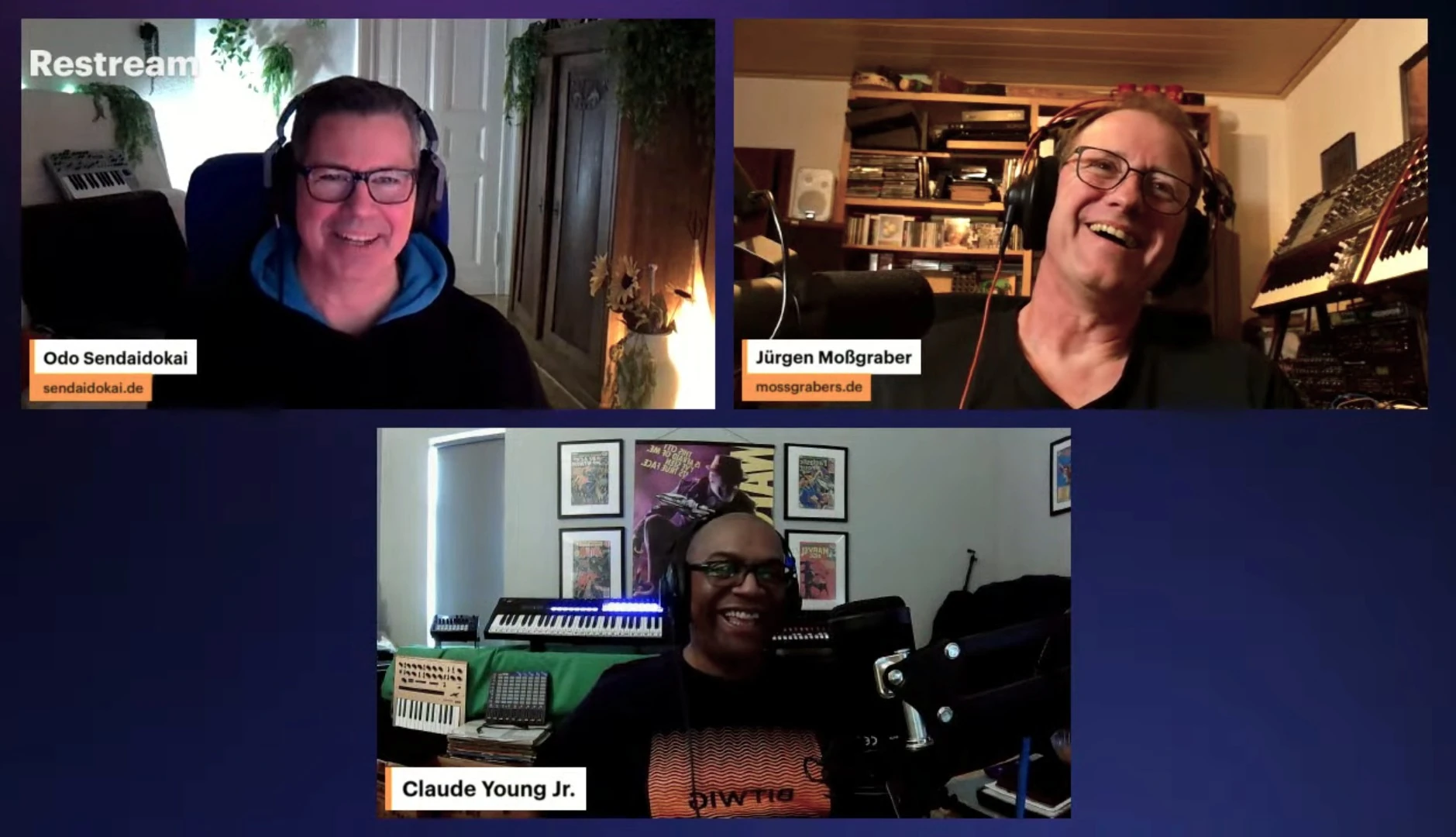
Odo Sendaidokai - Jürgen Moßgraber - Claude Young Jr.
Introduction
Claude Young is a legendary figure in Detroit techno, a true catalyst of ideas whose influence has shaped electronic music for over three decades . Born in 1970 in Detroit, he grew up surrounded by music royalty—his father was a legendary radio DJ who hosted David Bowie, Elton John, and Prince at their home . After helping Jeff Mills on his radio show in the early ’90s, Young launched his own career with releases on his Utensil label and quickly became one of Detroit’s leading DJs and producers .
Young’s productions filter the lush melodic elements of Motor City with the harder, minimalist stream of techno pioneers like Robert Hood and Jeff Mills, creating music that lacks neither emotion nor hard-hitting trance . His 1996 DJ-Kicks compilation was hailed as perhaps the best DJ mix to come out of Detroit since Jeff Mills, and his debut album “Soft Thru” (1997) earned widespread praise for uniting minimalism with melody . In July 2023, Young announced his retirement from DJing, stating “It’s time to regenerate,” though he continues to produce music and work on new projects .
Today, Young is not only a producer and former world-class DJ but also a Bitwig Certified Trainer, videographer, and sci-fi enthusiast who has seeded music scenes around the globe .
Technical & Musical Projects
Record Labels Founded
- Utensil Records: His own label where he debuted with the “One Complete Revolution” EP and released work by Terrence Dixon, Population One, and Walt J
- DOW Records: Another of his labels, where he recorded as Project 625
- Frictional Records: His third label, where he collaborated with Anthony “Shake” Shakir
- Seventh City Records: A label he helped found during Detroit’s techno renaissance
- Acacia Records: Another important label he was involved with
Notable Releases
- DJ-Kicks (1996) – The third installment of the iconic mix series, widely praised
- Soft Thru (1997) – Debut album on Dutch Elypsia Records
- One Nine Eight Four (2005) – Released on his own cynet media label
- Incidental Introspection EP (2024) – Recent release on Colour and Pitch
- Releases on DJAX-Up-Beats, Emissions Audio Output Recordings, and Tresor Records
Remixes & Edits
- High-profile remixes for Inner City, Astral Pilot, Innerzone Orchestra, Joey Beltram, Slam (with Ian O’Brien), Technasia, Gary Numan, Carl Craig, and 4Hero
- Edits for major labels including Warner Brothers, RCA Records, and Sony Music Entertainment
- Work on the soundtrack for Mamoru Oshii’s Ghost in the Shell (Sony Playstation)
Collaborations & Aliases
- Different World: A techno duo with long-time friend and production partner Takasi Nakajima
- Brother From Another Planet: Collaboration with Dan Bell on 7th City
- Rhythm Formation: Project for Acacia Records
- Being: Single for Andrew Weatherall’s Emissions Audio Output Recordings
- Project 625: Recordings for DOW Records
Bitwig Projects
- Bitwig Certified Trainer: Officially certified to teach Bitwig Studio (6:45)
- Cinematic Synth Sounds Sound Package: Official Bitwig sound content package featuring 10 multisampled instruments and 30 dynamic presets, created in partnership with Bitwig and Reverb.com
Technical Workflow
- Uses Bome MIDI Translator Pro as the centerpiece of his setup for remapping controllers (1:09:36)
- Built his own workflow using Pure Data (Pd) for randomizing MIDI signals across multiple tracks
- Programs all melodic parts in a single MIDI clip using different MIDI channels, with each channel feeding separate tracks for bass, chords, melody, etc. (1:16:40)
Other Information
Background & Early Life
- Born the son of legendary WJLB radio personality Claude Young Sr., who was responsible for million-selling records for artists like David Bowie, Elton John, Isaac Hayes, and Prince
- Grew up meeting music royalty as a child, including David Bowie, Elton John, and Prince
- Has a gold record for David Bowie’s “Young American” and Elton John’s “Benny and the Jets” on his wall
International Career
- Moved to London in 1995, embarking on worldwide DJ tours for nearly a decade
- Lived in Glasgow, Scotland for five years where he had a studio built by a friend
- Relocated to Tokyo in 2006/2007, where he got married, had a son, and ran cynet-media Japan with his wife
- Has performed in Spain, Japan, China, Germany, Switzerland, Ireland, Australia, France, and Austria
Retirement from DJing
- Announced his retirement from DJing in July 2023, stating “It’s time to regenerate”
- Cited losing the passion for the “scene” part of the industry, feeling bored and annoyed with the whole thing
- Plans to focus on production, scoring projects, and running a private mail-order record business
- Was commissioned with Takasi Nakajima to score music for an exhibition in Japan for 2025
- Received words of support from Jeff Mills and Surgeon
Philosophy & Sound
- Prefers pared-down tracks that reflect the essence of techno—intricate yet abstracted geometries
- His style is described as “eclectic and electric,” drawing comparisons to Jimi Hendrix
- Embraces simplicity, clean frequency ranges, and avoiding heavy presets that muddy the mix
- Believes in using effects to add color and positioning without sacrificing dynamics
Physical Media & Vinyl
- Inherited 13,000 records from his father
- Plans to start a Discogs shop with a cafe and vinyl listening station in Detroit
- Appreciates Japan’s physical culture where people value owning real things
Other Interests
- Videographer and sci-fi junkie
- Apple computer expert
- Also known under aliases: Brother From Another Planet, De-Yang Crew, DJ 2120, and Dub Street Posse
Claude talked about growing up in Detroit with a father who was the first black radio DJ to play a wide variety of music. He recounted meeting famous personalities such as David Bowie, Elton John, Falco, and many more. He also discussed how he went to Australia to work instead of Ritchie Hawtin.
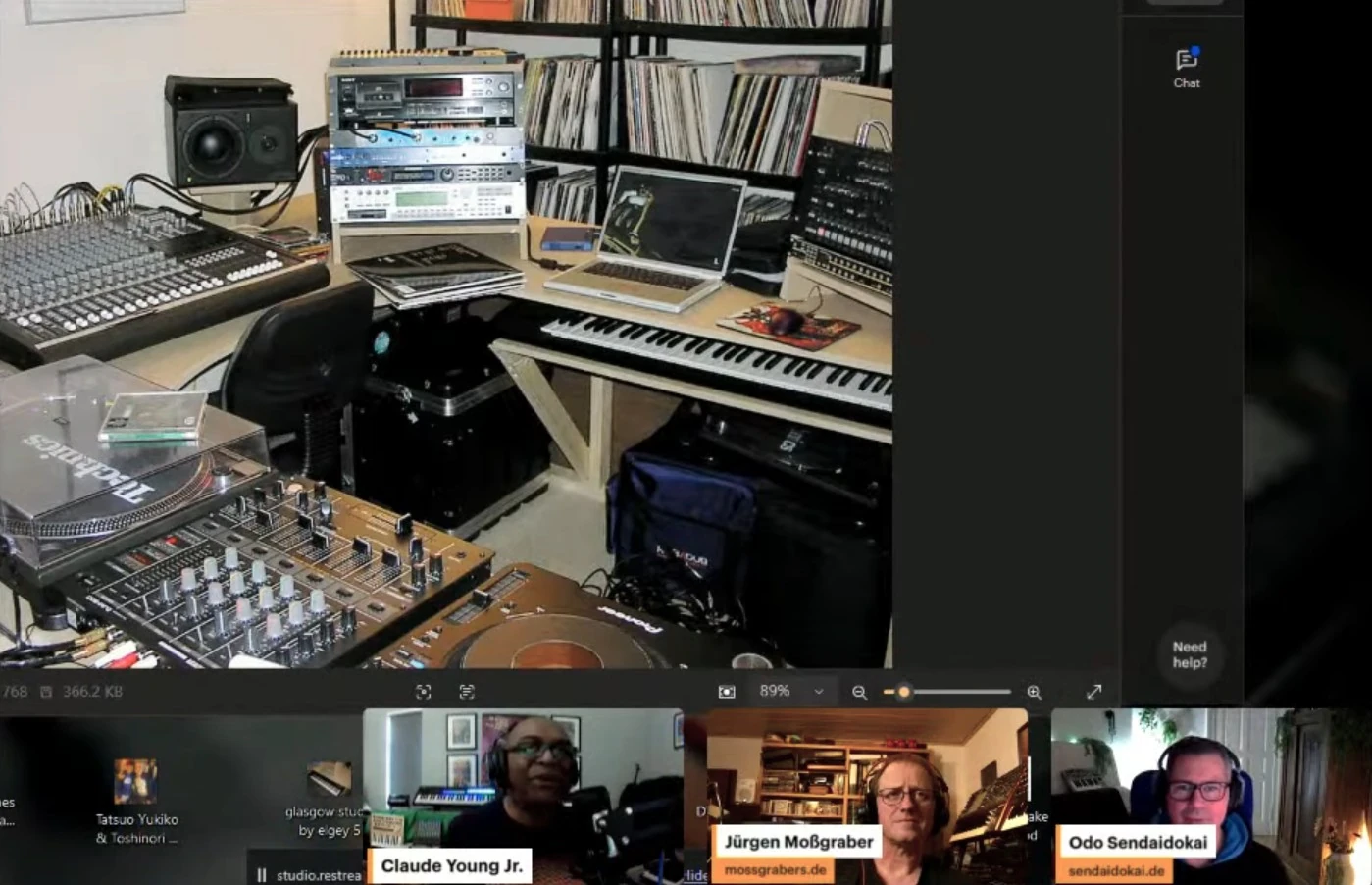
Studio of Claude Young Jr.
His life journey from Detroit to London, Hamburg, Berlin, Tokyo, and now back to Detroit is peppered with many interesting stories and wonderful people such as Takasi Nakajima Daniell Bell, Robert Hood, Anthony Shakir , Christian Vogel, Westbam, and many well-known names from the 90s techno scene who are still active today.
We talked a bit about Bitwig and the new version 6, which is still in beta, and we also geeked out about various controllers and workflows. But listen for yourself and, above all, subscribe to his exclusive social media account on Bluesky and, of course, his YouTube channel.
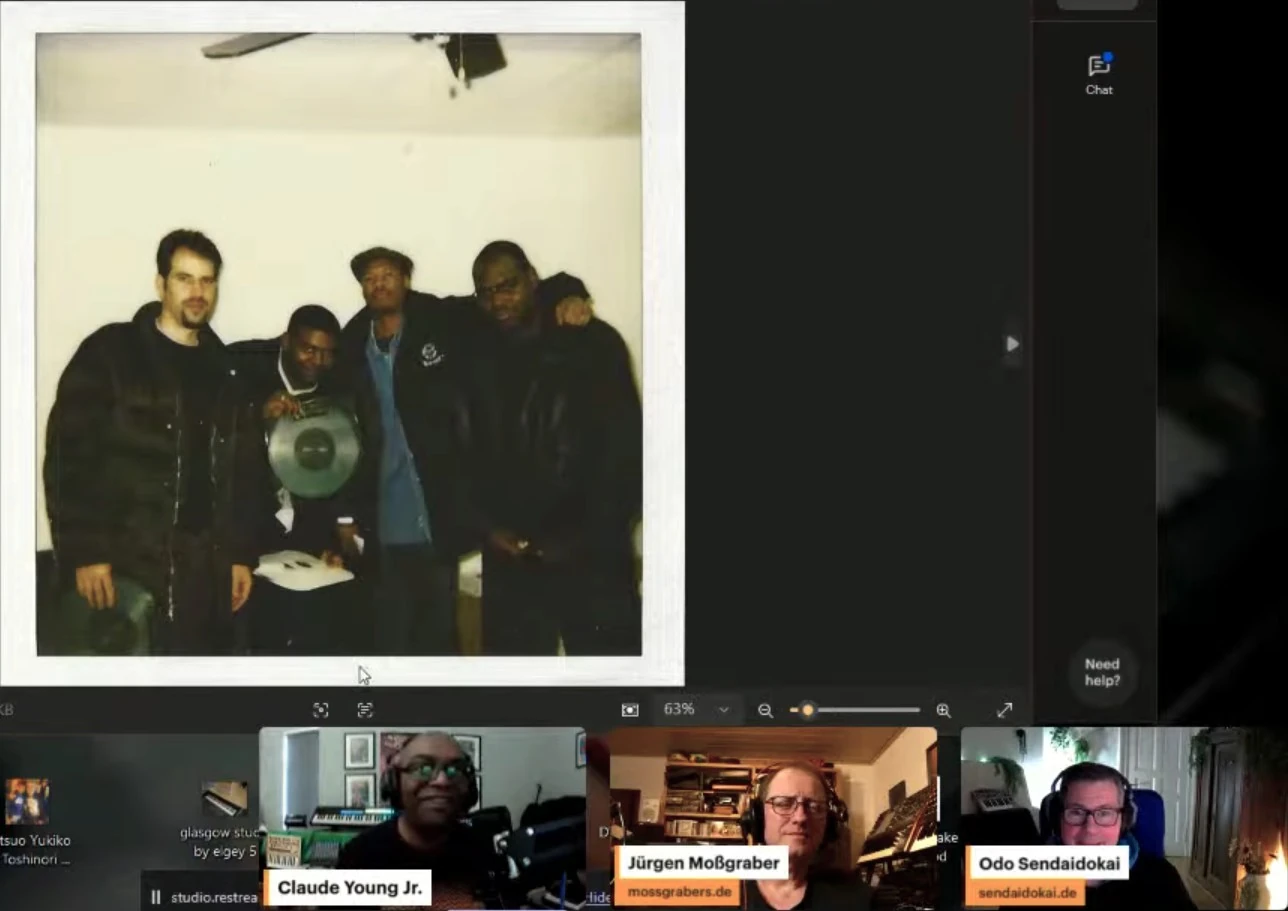
Musicproducers Claude Young Jr.
Because there’s a lot in the pipeline on YouTube and maybe even in the real world, with a real place where the community can meet. Keep your fingers crossed or help out so that Claude can come to Superbooth in Berlin.
It was a great pleasure to talk to Claude. He’s a wonderful person with a very infectious positive vibe that we should all try to emulate, at least a little bit.
Claude Young Jr Studio in Glasgow Scotland
Daniell Bell , Claude Young, Robert Hood, Anthony Shakir
Links and more information about and from Claude Young Jr
Social Media - Claude Young
- Bluesky https://bsky.app/profile/claudeyoung.bsky.social
- YouTube https://www.youtube.com/@ClaudeYoung
More infos
- Bitwig Certified Trainer https://www.bitwig.com/de/artists/claude-young-7/
- Discogs: https://www.discogs.com/de/artist/879-Claude-Young
- Bandcamp: https://claudeyoungjr-celestialbodies.bandcamp.com/
- Short Documentary “Claude Young: Living In the Now” https://shortfilmsmatter.com/7028/claude-young-living-in-the-now
- Groove “Interview"Claude Young: Charts from the Past (Juni/Juli 1998)” https://groove.de/2023/07/13/claude-young-charts-from-the-past-juni-juli-1998/
- Interview on World Techno Nation with Claude Young https://web.archive.org/web/20020808103045/http://worldtechnonation.com/ClaudeYoungInterview.htm
- Resident Advisor Interview (2011) https://de.ra.co/features/1398
Timetable
5:00 - Show Intro & Guest Welcome - Hosts Jürgen and Odo welcome Claude Young, a DJ legend, music producer, Bitwig Certified Trainer, and a Detroit original. Claude joins from Detroit.
6:45 - Claude’s Background & Comic Books - Claude shares his love for comic books, showing posters of Watchmen, Fantastic 4, and Black Panther. He recently found his childhood comic collection including first editions.
9:04 - Growing Up in Detroit - Claude describes growing up in Detroit, the home of Motown and American soul music. His father was a famous radio DJ, and he met David Bowie, Elton John, and Prince as a child. His father gave him gold records for Young American and Benny and the Jets.
13:47 - Starting in Music Business - Claude started as an intern at a radio station, making blind research calls. His boss discovered he was Claude Young’s son and offered him a mix show. He won a competition and got a slot for Saturday night mixes.
17:25 - Early Edits & Remixes - Claude’s first productions were edits, including the radio edit for Tommy MTO and Frankie Bones’ “Dangerous on the Dance Floor.” He also did edits for Kevin Saunderson (Reese, Inner City).
19:51 - First Gear - Claude bought an EMU SP12 sampler and a Roland JD800. He sampled friends’ drum machines (like Dan Bell’s 909) and made his first records with just a JD800, SP12, and a Mackie mixer.
22:20 - Starting Dowo Records - Claude started Dowo Records with his friend David Whiteside (a butcher). His first tracks got attention in England and snowballed into remixes and touring.
23:31 - International DJ Career - Claude’s first international gig was in Australia, replacing Richie Hawtin on a tour. He stayed for three months, got a residency at the Synagogue in Adelaide, and met HMC and GT.
26:33 - Scotland & UK Scene - Claude played at Pure in Edinburgh and befriended Neil Landstrumm, Tobias Schmidt, Christian Vogle, and others. He later relocated to England for most of the 90s and early 2000s.
30:39 - European vs US Music Culture - Claude reflects on how European club culture is more community-oriented, while Detroit has a “gunslinger” attitude where “everybody’s famous.”
32:41 - Detroit, New York, Chicago, LA Techno - Claude discusses the Trinity of American dance music: Detroit (techno), Chicago (house), and New York (freestyle, garage), with LA’s electro-funk scene.
34:39 - Detroit Techno Today - Claude notes that young people are carrying on the tradition, and people are moving to Detroit because it’s still affordable and underground.
36:02 - Old Studio Photos - Claude shares photos of his studio in Glasgow with a circular table, Mackie mixer, Kurzweil K2000, Novation Drum Station, and other gear. He also shows a photo with Daniel Bell, Robert Hood, and Anthony Shakir.
38:01 - Self-Taught Musician - Claude is entirely self-taught. He uses the Nashville number system, plays everything in C, and transposes with Bitwig’s note transposer.
40:24 - DAWs & Why Bitwig - Claude used Logic (from the Windows days) and tried Reason and Ableton. Bitwig was a “religious experience” with modulators as the game-changer. He had a negative experience with Ableton’s attitude and switched to Bitwig after meeting Mia from Bitwig.
46:43 - Bitwig Versions & Workflows - Claude started with Bitwig pre-modulators and loves the layer system, round-robin features, and the flexi. He’s a fan of Jürgen’s Generic Flexi device.
48:41 - Life in Japan - Claude moved to Tokyo in 2006/2007, got married, and had a son. He appreciates Japan’s physical culture, high-quality tech, and love for physical media (CDs, vinyl).
53:25 - Detroit Record Shop - Claude inherited 13,000 records from his father and plans to open a Discogs shop with a cafe and vinyl listening station in Detroit. He also wants to offer Bitwig training there.
55:15 - Plans for YouTube & Radio Show - Claude wants to start a YouTube channel and a radio-style show featuring new plugins, Bitwig updates, and user-submitted music.
58:16 - Frankfurt & Delirium Records - Claude shares memories of Delirium records in Frankfurt, where Ricardo Villalobos worked. He reflects on the magic of small record stores.
1:00:21 - Real-World Techno & Bands - Claude discusses techno bands like Klangphonics and his love for Radiohead. He wants to produce bands and create interesting music with live instruments.
1:04:04 - Free Tools & Affinity - Claude mentions free tools like Affinity (now free), DaVinci Resolve, and the importance of accessible creative software.
1:06:15 - VST3, ASIO & CLAP Open Source - Jürgen explains Steinberg open-sourcing VST3 under MIT license and ASIO under dual license. Claude believes CLAP was the catalyst and calls it “the best time to be alive.”
1:09:36 - Controllers & Bome MIDI Translator - Claude uses Bome MIDI Translator Pro as the centerpiece of his setup. He remaps his Launchkey Mini to control velocity and device parameters, sending everything into the Generic Flexi.
1:12:13 - Bitwig on Linux - Claude wants to run Bitwig on an old MacBook with Linux. Odo offers to help with installation issues, and Claude prefers Linux to avoid upgrading Windows.
1:16:40 - Claude’s Bitwig Workflow - Claude programs all melodic parts in one MIDI clip using different MIDI channels. Each channel feeds into separate tracks for bass, chords, melody, etc. He views everything in one arranger window for better overview.
1:24:00 - Bitwig 6 Beta & Retrospective Recording - Claude uses the beta but warns against working on important projects. He appreciates the new project recording feature (retrospective recording) but still uses Rewind from Monkey C.
1:29:00 - Tape Loops & Ambient Album - Claude is working on an ambient album inspired by 10 CC’s tape loop techniques. He plans to use odd-length audio loops and faders to create loose, rock-and-roll style textures.
1:31:40 - Pure Data & Bitwig Grid - Claude is a Pure Data (PD) user and appreciates that Bitwig’s Grid offers similar functionality built-in. He often builds things at a higher level using layers and channel switches without even going into the Grid.
1:35:24 - Superbooth Plans - Claude plans to attend Superbooth 2027 in Berlin. The hosts discuss recording a podcast from there and meeting up.
1:39:07 - What’s Next - Claude wants to focus on teaching, producing bands, his YouTube channel, and record shop. He encourages people to reach out and ask questions.
1:41:39 - Host Updates - Odo is working on tutorials and a drum and bass version of the border machine project. Jürgen is working on a new border machine album, Convertive MOS updates, and Generic Flexi improvements.
1:49:05 - Farewell & Community - The hosts encourage building a Bitwig community and family. Claude thanks everyone, and the show signs off with “make some funky music.”