BiCoTa – Episode #8 Thavius Beck
Posted on Sonntag, Juli 12, 2026
Show Notes
In this inspiring episode of the Picota Bitwig Community Talk, hosts Odo and Jürgen welcome electronic musician, educator, and Bitwig Certified Trainer Thavius Beck.
Thavius Beck is an American electronic musician, producer, rapper, multi-instrumentalist, and one of the most internationally renowned educators for digital music production . Born 1979 in London, he grew up in Los Angeles, where he began his career in the late 1990s at the legendary Project Blowed open-mic workshop in Leimert Park .
His musical journey led him from being a member of the hip-hop collective Global Phlowtations to solo releases under the pseudonym Adlib, and finally to international recognition as Thavius Beck . His sound – a unique blend of hip-hop, acid jazz, techno, industrial, and soul with a focus on deep bass and distorted samples – is often placed somewhere between DJ Shadow and Orbital.
We are talking about his remarkable journey from a self-taught teenager in Minneapolis to becoming a professor at Berkeley and a key figure in the LA beat scene. Thavius shares his origin story-growing up with soul, funk, and jazz fusion records, playing saxophone in school bands, and discovering sampling through a Casio SK1 and pause mixes on a dual cassette deck. At age 12, he recorded his first song “Tylenol” at an arts camp using a Roland S50 sampler and Ensoniq SQ2 sequencer, blending Jean-Luc Ponty’s jazz fusion with hip-hop and Nine Inch Nails influences-a combination that would define his eclectic musical palette. He also reveals his unexpected first DAW: the PlayStation’s MTV Music Generator, on which he made two full albums.
Collaborations with Music Industry Giants
Thavius Beck has collaborated with an impressive list of artists. Particularly notable are:
- Saul Williams: He produced several tracks for Williams’ album The Inevitable Rise and Liberation of NiggyTardust! (2007), which was co-produced by Trent Reznor of Nine Inch Nails .
- Nine Inch Nails: He contributed a remix of “Survivalism” to Reznor’s Year Zero Remixed .
- Further Collaborations: He worked with artists like Skylar Grey, Nas, Busdriver, Subtitle, K-the-I???, and Mars Volta singer Cedric Bixler-Zavala .
Solo Discography (Selection)
His solo career includes numerous releases on renowned labels :
| Year | Title | Label |
|---|---|---|
| 2004 | Decomposition | Mush Records |
| 2006 | Thru | Mush Records |
| 2009 | Dialogue | Big Dada |
| 2012 | The Most Beautiful Ugly | Plug Research |
| 2017 | Technol O.G. | Hit+Run |
The Sought-After Educator and Bitwig Trainer
In addition to his music career, Thavius Beck is primarily known as an outstanding educator. For a long time, he was a prominent figure in the Ableton Live scene, developed curricula for the music school Dubspot, and became a certified Ableton trainer in 2009 . For several years, however, he has been closely associated with Bitwig Studio: he is a Bitwig Certified Trainer, has created video tutorial series for Bitwig and Ask.Video, and is the lead instructor for the official Bitwig Trainer Certification Program . He also holds workshops around the world, including at Superbooth in Berlin . He was also an Assistant Professor at Berklee College of Music in New York .
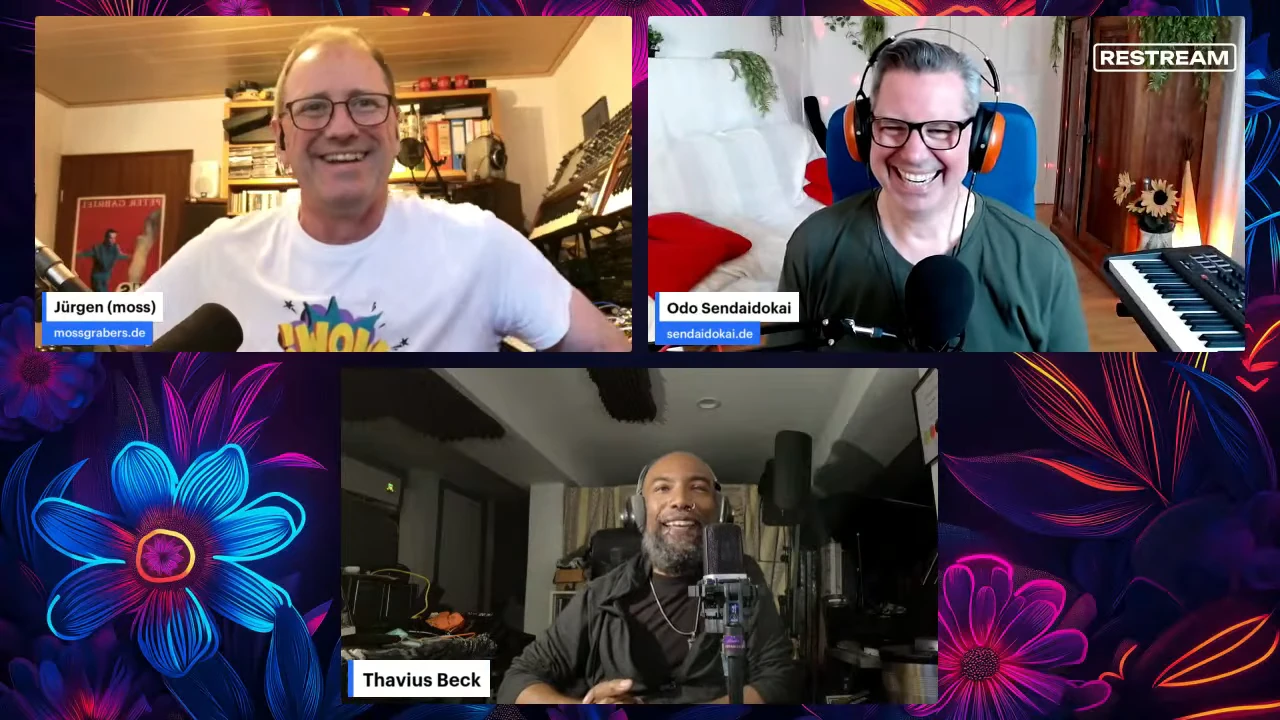
Odo Sendaidokai - Jürgen Moßgraber - Thavius Beck
The conversation then explores Thavius’ transition into teaching, which began accidentally when his unconventional Ableton workflow caught the attention of the company’s VP at NAMM, leading to his certification in 2008. He later became a Bitwig Certified Trainer in 2015 and joined Berkeley NYC as faculty, rewriting syllabi and teaching everything from pop production to modular synthesis. Thavius shares his teaching philosophy-focusing on artistic workflow rather than feature lists, structuring beginner workshops as a clear path through Bitwig’s complexity while allowing advanced sessions to be more improvised and show the decision-making process, including mistakes. He also provides an inside look at the Bitwig certification program, which he moderates, detailing the four-session structure and the final presentation exam that pushes candidates to demonstrate their teaching ability.
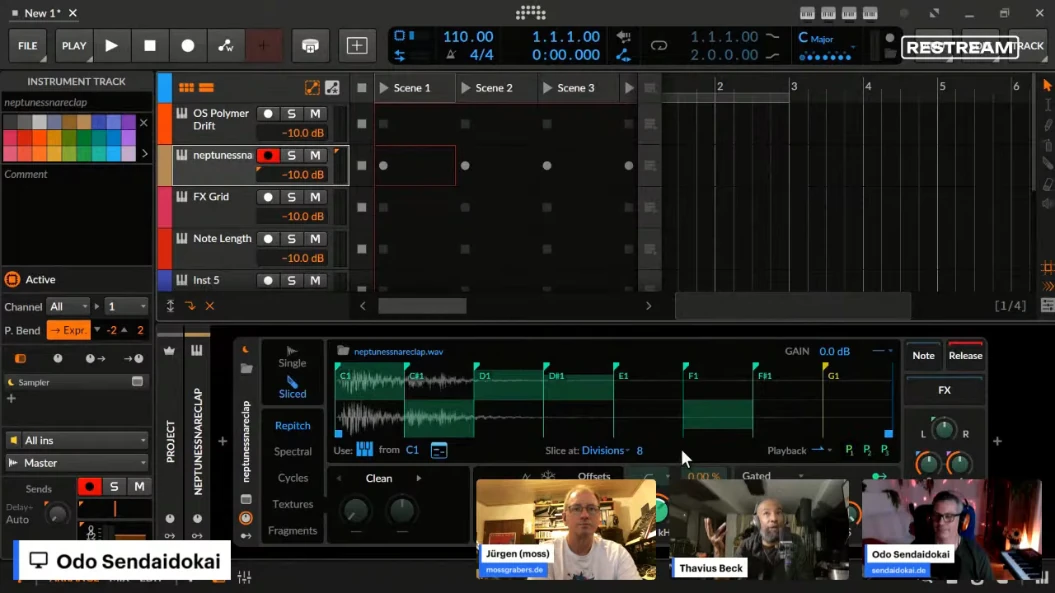
A significant portion of the episode is dedicated to Thavius’ deep dive into Bitwig Studio 6.1’s new sampler features, which he calls “eye-opening” and “unprecedented” in any other sampler. He demonstrates advanced techniques including slice parameter zones that allow individual processing of each sliced sample (filtering hi-hats separately, panning percussion, altering pitch per slice), the analog pitch mode that adds tape-style saturation for fatter drums, and the fragments mode for creating rhythmic granular textures. He contrasts stock plugins versus third-party solutions, explaining his preference for building custom effects in the Grid-like recreating the classic “Insta Jungle” stutter effect with additional features-and praises Bitwig’s device versioning system that preserves old device versions across updates. Throughout, Thavius emphasizes his philosophy of using fewer sounds and making them do more through modulation, demonstrating live how simple instruments like the Organ can create complex, evolving ambient textures with just LFOs and reverb.
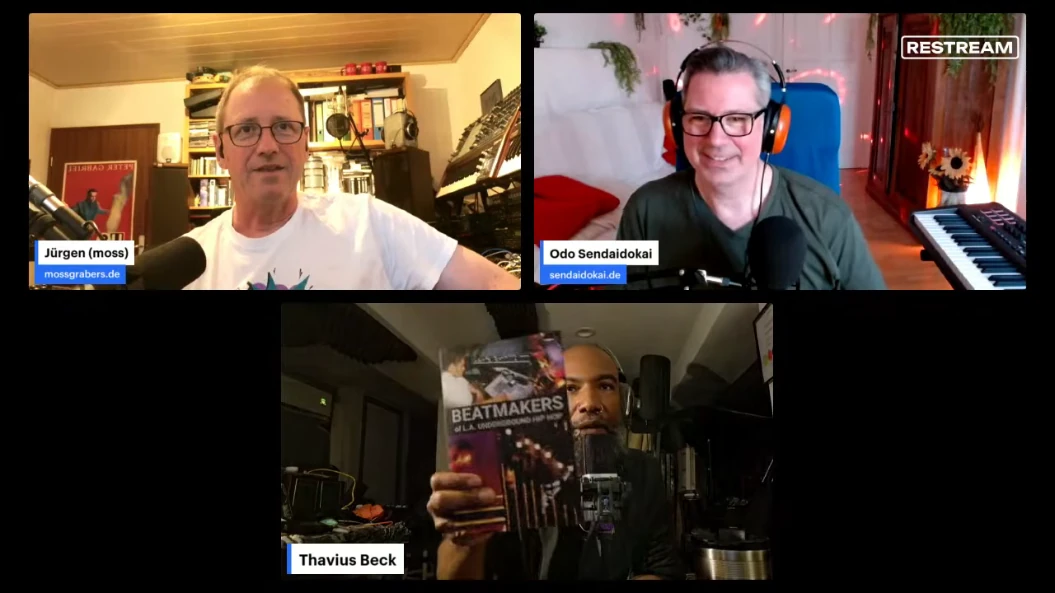
Book - eat Makers of LA Underground Hip Hop
The episode also covers Thavius’ current studio setup (Moog Sub37, SP-404 MkII, Eurorack, Deluge), his preference for Bitwig over Ableton due to workflow and inspiration, and his recent feature in the book “Beat Makers of LA Underground Hip Hop,” an oral history of the scene that produced Flying Lotus and his contemporaries. He reflects on his time in LA, the legendary Low-End Theory club, and the loss of friend and producer Ras G. Looking ahead, Thavius announces plans to release 2-3 creative projects (including ambient music) via Bandcamp by year’s end, focusing on being an artist again after years of teaching and family obligations. The show closes with host updates: Odo’s upcoming tutorials and music releases, Jürgen’s Convertive Musle v1.9 with 5 new formats including Deluge read/write support, and previews of future guests Jeff Kirkwood (scripting, AI) and Nicolò Grigetti (touring with Bitwig).
Bitwig 6.1 Beta - Sampler
Sources
- Bitwig Certified Trainer – Thavius Beck
- Thavius Beck – Wikipedia
- Berklee College of Music – Thavius Beck
- Bitwig Artist Profile – Thavius Beck
- Discogs – Thavius Beck
- SoundHound – Thavius Beck
- Bitwig Trainer Certification 2026
- macProVideo – Bitwig Studio 2: The Modulators Explored
- Grokipedia – Thavius Beck
- Ninja Tune – Thavius Beck
- macProVideo – Bitwig Studio 3: The Grid Explained and Explored
Chapter List
0:00 - Show Intro & Hosts Welcome - Opening music and hosts Jürgen and Odo introduce the show. They mention the heat wave in Germany and preview the episode’s focus on teaching, Bitwig tips, and the 6.1 beta.
5:45 - Guest Introduction: Thavius Beck - Jürgen and Odo welcome Thavius Beck. He shares he’s currently in Brooklyn, New York, recovering from a recent heat wave. The hosts ask him about his location and the weather.
7:50 - Thavius’ Musical Background - Thavius shares his origin story: raised by a single mother who played soul, funk, and jazz fusion records at home (Spyro Gyra, Pat Metheny, Earth Wind & Fire, Maze). He started playing alto saxophone in 4th grade (1988/89) and switched to tenor sax in 6th grade, becoming the best musician in his school’s jazz band. He also developed an early love for hip-hop.
10:00 - Early Hip-Hop & Sampling Origins - Thavius discusses his first sampler-the Casio SK1 with 1.5 seconds of sampling time. He used double cassette decks with high-speed dubbing to double the sampling time. He describes making “pause mixes” and experimenting with sampling loops from radio, all while being inspired by Public Enemy and the hip-hop ethos of creating entire albums alone.
13:00 - First Studio Session at Age 12 - At age 12 (1992/93), Thavius attended an arts camp at Morehead College in Minnesota where he had two weeks to compose and record a song. He used a Roland S50 sampler and Ensoniq SQ2 synth sequencer. His song “Tylenol” was inspired by Jean-Luc Ponty’s “Cosmic Messenger” combined with hip-hop and Nine Inch Nails influences. This experience made him realize he wanted to pursue music professionally.
17:30 - Rock & Metal Influences - Thavius expands on his eclectic palette: Megadeth, Slayer, Nirvana, Soundgarden (Chris Cornell was a favorite), and working with The Mars Volta. He toured with them in 2004 and later had their lead singer Cedric Bixler-Zavala as a guest on his first record. He also started playing bass guitar at age 12, though he admits he didn’t take lessons seriously.
21:30 - Ambient Music & Creative Freedom - Thavius explains why ambient music appeals to him now-he’s tired of formulaic drum patterns and genre constraints. He critiques how many genres are defined by one preset sound and one drum pattern, noting that “everyone wants to copy the first person who did it.” He encourages breaking free from conventions and doing “art for art’s sake.”
27:30 - LA Beat Scene & Global Flotation - Thavius moved to LA at 16 after being sent to live with his father. He formed a hip-hop collective called Global Flotation with people on his block, producing records and recording on a four-track. He became the “tech guy” who figured out equipment and showed others what he’d learned.
29:30 - MTV Music Generator & First DAW - Thavius reveals his first DAW was the PlayStation game MTV Music Generator (1999). He made two albums on it called “Operating the Generator” Volumes 1 and 2. The game allowed sampling from CDs, memory card saves, and had a full linear arranger-better than his Roland W30 workstation with only 7 seconds of 15kHz sampling time.
32:48 - Becoming an Ableton Certified Trainer - At NAMM, Thavius met Dave Hill Jr. (Ableton’s VP), who was intrigued by his unusual workflow. Dave visited his house and later invited Thavius to one of the first Ableton certification events. Thavius got certified, and since he had no high school diploma or college degree, this certificate became crucial for his career.
34:47 - Free Workshops at LA Movie Theater - In 2009, Thavius started free public Ableton workshops at the Downtown Independent movie theater in LA. The owner allowed him to use a back room for free as long as he didn’t charge and the theater could sell concessions. He held workshops every two weeks, which became very popular and launched his teaching career.
37:00 - Teaching at Berkeley - Thavius joined Berkeley NYC’s first year as a faculty member. He had to rewrite the syllabus and adapted it each year for the 10-month program. The curriculum was focused on current pop artists because students were paying $60,000 and wanted to make their money back. He also taught a modular synthesis class despite not having any Eurorack gear-he bought a bunch with money from consulting for Splice.
39:30 - Super Booth Workshops - Thavius discusses his approach to teaching at Superbooth. He structured the beginner workshop as a focused path through Bitwig’s “jungle” of features, emphasizing artistic workflow over feature lists. The advanced workshop was more improvised, showing his thought process, including mistakes and how to correct them-valuable for learning decision-making.
45:00 - Bitwig Certification Program - Thavius moderates the online Bitwig certification events (2 per year, 4 sessions of 2 hours). Topics include modulators, operators, the Grid, workflow, and teaching methods. The final session requires 5-minute presentations on assigned topics. Costs around €700-800. The next event is expected in October/November 2026. Follow Thavius on Instagram (@thaviusbeck) for announcements.
50:00 - Bitwig vs Ableton Workflow - Thavius explains why he prefers Bitwig: he used Ableton so much for work that he’s bored with it. Bitwig feels more inspiring with better layout, clearer information, and the ability to modulate anything. He uses the mixer view as full-screen VU meters and works primarily in the arrange panel. He no longer uses Ableton for production.
54:30 - Studio Tour: Sub37, SP-404, Deluge & Modular - Thavius gives a tour of his studio: Moog Sub37 (gifted by a friend), SP-404 MkII (used as hardware effects unit with a Grid device for control), Eurorack modular (3 cases), Push 3 (which he doesn’t like), Deluge, Polyend Tracker Plus, Novation Mono Circuit (used as analog drum machine). Bitwig is his centerpiece, with the Sub37 as his main controller.
57:00 - Bitwig 6.1 Sampler First Impressions - Thavius has been using the 6.1 beta daily since release. As a sample-based musician, he’s blown away-“there’s nothing else out there like it.” He’s been making 2-4 things daily, re-sampling from YouTube and old samples, finding the new features “eye-opening.” He emphasizes he’s not paid by Bitwig; he genuinely loves it.
1:01:00 - Stock Plugins vs Third Party - Thavius strongly prefers stock plugins for portability (projects don’t break when moving between computers). He often sees students with too many plugins causing problems. In Bitwig, he can build anything in the Grid that’s not already stock. He shares the example of rebuilding the “Insta Jungle” stutter effect using the Grid’s recorder module.
1:04:00 - Building Effects in the Grid - Thavius demonstrates rebuilding a classic third-party stutter effect (Insta Jungle) using Bitwig’s Grid. He used the recorder module (in the Delay category) with trigger inputs for recording and playback. He then added features the original didn’t have-pitch shifting and grain size control-creating a native Bitwig device that’s even more powerful.
1:06:40 - Bitwig’s Device Versioning Feature - The hosts discuss Bitwig’s versioning system, which preserves old versions of stock devices when they’re updated. For example, drum modules that were updated still keep the original sound. Thavius highlights this as huge for consistency-you never lose the sound of old projects.
1:09:30 - Answering Chat Questions - Live Q&A session. Thavius answers a question about recording note repeats: you can route notes from one track to another using the input settings on an instrument track. He also shares a tip combining Stepwise and Note Repeats with Note Length for random drum ratchets.
1:13:00 - Controllers & Controller Scripts - Thavius discusses using DrivenByMoss scripts (by Jürgen) with Push 2 and Launchpad. He currently uses Rotocontrol (sent by Bitwig) with his Sub37. He likes but doesn’t love Rotocontrol due to quirks: buttons don’t work in plugin mode, only the first 8 knobs can record motion controls. He finds it “not fully thought through.”
1:17:30 - Compact Hardware & Firmware Hacking - Thavius contrasts Push 3 (too heavy, 10 pounds) with compact alternatives: OP-XY, DirtyWave M8, Polyend Tracker Mini, and Ableton Move. He uses Ableton Move with a community firmware extension called “Schwang” (or “Move Everything”), which adds samplers, sequencers, and even Radio Garden for sampling from global radio stations.
1:22:20 - Hacking the Deluge Firmware - Thavius shares a proud moment: when the Deluge firmware was open-sourced, he taught himself C++ and fixed the tempo change behavior. Previously, tempo changed in increments of 4 BPM and you had to hold the knob for single increments. He submitted a fix that changed it to 1 BPM increments-the way it works now is because of his contribution.
1:23:40 - Jamming & Stereo Tracking Workflow - Inspired by Alessandro Cortini (Nine Inch Nails), Thavius adopted the philosophy of jamming and capturing raw energy as stereo mixes rather than multitracking. He tracks hardware jams live into Bitwig as stereo files-“if it’s a little dirty and messy, that’s okay.” This approach preserves the energy of the moment.
1:29:00 - Book Reveal: “Beat Makers of LA Underground Hip Hop” - Thavius reveals he’s featured in a new book by Parker Pubs. It’s an oral history of the LA beat scene, covering the time leading up to the legendary Low-End Theory club. Other featured artists include DāM-FunK, Daedelus, Omid Wizard, and Flying Lotus. Available on Lulu as hardcover/paperback for ~€20.
1:31:30 - Remembering Ras G & the LA Beat Scene - Thavius reflects on Ras G, a beloved LA beat maker who passed away suddenly. He describes Ras G as humble and not competitive. There’s now a mural of him outside Chaos Network in Leimert Park, LA. Thavius also mentions Poobah Records and the tight-knit, competitive-but-family-like LA producer community.
1:37:00 - Bitwig Milestones - Thavius identifies key Bitwig milestones: the ability to edit audio inside clips (v1), The Grid (v3.1), and recent tools like Harmonic Split. He appreciates that each feature allowed him to break habits from Ableton. Project remotes, track remotes, and mapping multiple controllers to the same parameter are also game-changers.
1:45:40 - Sampler Deep Dive: Slice Parameter Zones - Thavius demonstrates a hidden 6.1 feature: slice zones. After slicing a drum break, each slice can be processed individually-adding filters, changing pitch, or panning per slice. For example, high-pass the hi-hats while leaving other slices untouched. This is unprecedented in other samplers.
1:49:00 - Analog vs Clean Pitch Mode - Thavius shows the pitch mode’s analog setting, which adds tape-style saturation. For drums, it instantly makes them sound fatter and grittier without bitcrushing. He says using this is like having built-in saturation inside the sampler.
1:50:20 - Fragments Mode Demo - Live demonstration of the fragments (granular) mode. Thavius shows how to create rhythmic textures by setting grain size to note values (16th notes) and adjusting the shape envelope for a quick attack. By setting the speed to zero and modulating play position, you can create complex, random percussive textures.
1:56:00 - Less Is More: Ambient Sound Design - The group discusses how Bitwig’s sampler allows using fewer sounds because each can do so much more. Thavius prefers creating motion with modulation rather than layering many sounds. Odo demonstrates playing one chord for 5 minutes, changing filter and modulation settings-creating “waves and wavering.”
2:00:00 - Organ & Modulation Demo - Live jam using Bitwig’s Organ instrument. Thavius modulates drawbars (harmonics) with slow LFOs, adding reverb and delay. The group discusses how simple tools can create complex, beautiful, haunting textures. Jürgen notes that “you can have all these tools, but you don’t have to make the most complicated music.”
2:04:00 - Why Thavius Supports Bitwig - Thavius explains his personal support for Bitwig: he considers CEO Placidus an actual friend, respects their sustainable development approach, and appreciates their responsible growth. He’s not employed by Bitwig-he genuinely believes in what they’re doing and wants them to succeed.
2:08:00 - Linux & Cross-Platform Development - Thavius discusses Bitwig’s touchscreen history: they partnered with Microsoft to show off the Surface Book with Bitwig’s touch interface. He still has the Surface Book Microsoft gave him. He doubts Bitwig will ever come to iPad due to resource constraints. He mentions using Linux on a Surface Go with CakeOS, and confirms Bitwig works great there too.
2:10:50 - Future Plans & Releases - Thavius plans to release 2-3 creative projects by the end of the year-including an ambient album-through Bandcamp (not Spotify). He’s focusing on being an artist again after years of teaching and family obligations. He wants to “feel like a creative person again” and maintain integrity in his art.
2:12:00 - Host Updates & Future Shows - Odo and Jürgen share their own plans: Odo has unreleased music and tutorials on compression and sound design coming. Jürgen is finishing a “border machine” project with his Swiss friend and a 25-year-old rock band album. Jürgen also announces Convertive Musle v1.9 with 5 new formats, including Deluge read/write support.
2:17:30 - Next Shows Preview - September 13, 2026: Jeff Kirkwood-scripting, AI integration, and custom Bitwig scripts. November 15, 2026: Nicolò Grigetti-touring musician using Bitwig exclusively for live gigs.
2:19:30 - Farewell & Outro - Final thanks to Thavius. He reminds viewers to follow him on Instagram for certification event announcements (expected October 2026). Hosts thank the chat, remind viewers to leave comments, and sign off with their signature tagline.