BiCoTa – Episode #9 Jeffrey Kirkwood West
Posted on Sonntag, Sept. 20, 2026
Show Notes
Jeff Kirkwood - Don’t Take Defaults as the Standard
Jeff Kirkwood is a producer, live performer, and controller specialist from Fairfield, Iowa - a small town of about 10,000 people - with musical roots reaching back to Chicago, where house music and imported UK records shaped his earliest identity. He was deeply into drum and bass and jungle when nobody else in his town was, digging through the small section at Record Collector in Iowa City for anything that said “Jungle” - eventually discovering Suburban Base, Metalheadz, and Goldie. He saved up and spent $10 on imported records while his friends paid $5 for domestic ones, because he was a junglist.
He and his friends started a youth club called The Beatbox in a basement under a gift card shop, where they would breakdance and DJ. His friend got funding from Iowa, and it grew - a computer lab, a boxing school, a big club room. They rented bars, did basement and house parties, and even rented the ballroom of a Best Western at 16. Jeff got into playing live on his computer, bringing his desktop and pressing play on Fast Tracker or Buzz Tracker.
Over the years he got into hardware - Moog Rogue, Juno 106, Jupiter, DX7, TX7, ESQ1, Octatrack, Monomachine - and still has the legacy ones. He built stands out of wood and a desk with sliders, a “topper” that fits against the wall and stays compact. He is really into the ergonomics of synth control - very personal, requiring lots of iteration.
Odo Sendaidokai - Jürgen Moßgraber - Jeffrey Kirkwood
IT Background
Jeff’s background is in user interface design and programming. He worked on the game Saints Row at Deep Silver Volition. He did the UI - drew all the bitmaps, painted little drug paraphernalia you’d have to select with your D-pad. When he got there, all the UI was hard-coded in C++.
Now he really likes making tools for artists - they just need to be a little bit better than what they currently have, and they say, “Oh my God, that just saved me hours.” He is thinking about that with /CTRL - it’s gonna change the speed of iteration and getting to something usable.
Mapping more than 128 Parameters - Move to Bitwig-Studio
One of the main reasons Jeff moved to Bitwig: they allow mapping more than 128 parameters. He was stuck in Ableton Python world, found Moss’s tutorials, did Hello World, and went deep into the Bitwig API. He learned to program again - he already knew Java from Flash and ECMA script - and it was cool to wake that part of his brain for something with more purpose. He could turn on a light on his MIDI controller, change its color, change knob speed, reassign knobs - stuff people can’t do without programming.
Richie Hawtin posted on his Loop talk asking if anybody knows how. Jeff was in bed doom scrolling at 7 AM, said “Yeah, I know how to do that,” DMed Richie, and suddenly was talking to his hero.
/CTRL - build dynamic behavior, not static mappings
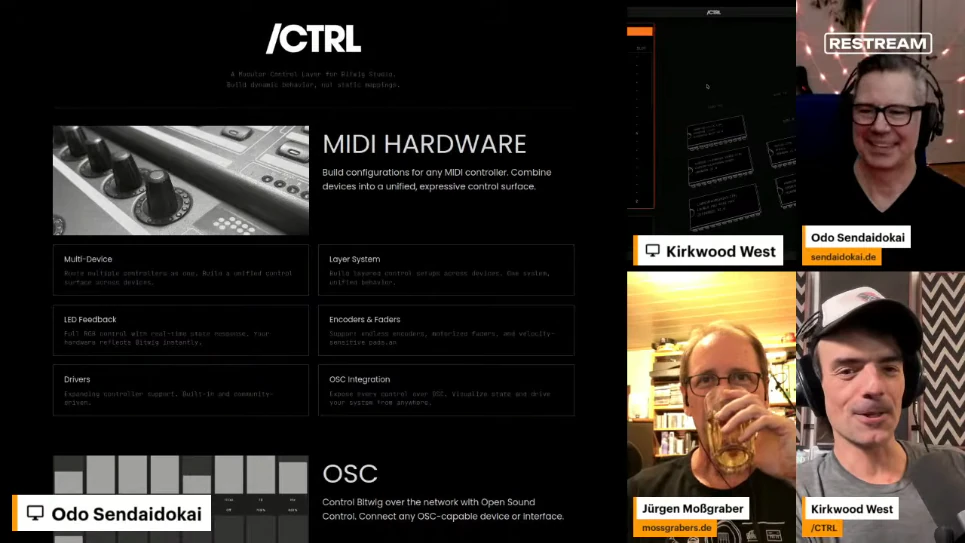
Odo Sendaidokai - Jürgen Moßgraber - Jeffrey Kirkwood
Jeff has been working on /CTRL (Slash Control) - a modular controller for Bitwig Studio. It puts a layer between Bitwig and tons of controllers, allowing you to use all as one. Normally you have one controller of eight, but you need 16. You can add any other controller and configure it simply.
The project started because his friend Cap needed a control surface - just OSC, but custom: two separate track banks, different remotes on different channels. Jeff hard coded it and thought it sucked that Cap would have this one controller just for his setup, with no reconfiguration. So he JSONified it - build all those things with JSON elements. He programmed drivers for Akai APC Mini MK2, Launchpad Mini MK3, MIDI Fighter Twister - each with different SysEx implementations. Novation gets a shout out for the best protocol publications, but each Launchpad has a different implementation.
In /CTRL, you create Bitwig API objects - like a track bank - and it creates endpoints for control. You navigate the TrackBank and add sub-components: volume, sends, pan. Then mapping. You set up a layer, run macros, stack layers.
The person using this software should never need to think about SysEx. The controller has to be in the library. Jeff is building up his controller library. He wants to work with more people. He wonders if he could do one remotely - possible but hard.
AI can get you places far pretty fast, but …
Jeff says AI can help with tech info, but you still have to verify it. It can do quite a bit of research. It can even implement the driver - he’s had it do it, but it’s never 100%. It gets to about 80%, and he spends most time on the last 20% fixing stuff. It usually makes poor architectural decisions.
The AI still makes mistakes in the Bitwig extension format even though they have all the data - how things should be marked, when things should be observed, what data should look like, what a flush statement is. If you don’t catch that stuff, you can cause serious problems. His take: AI can get you places far pretty fast, but with a close eye on the output.
KnobCon
Odo Sendaidokai - Jürgen Moßgraber - Jeffrey Kirkwood
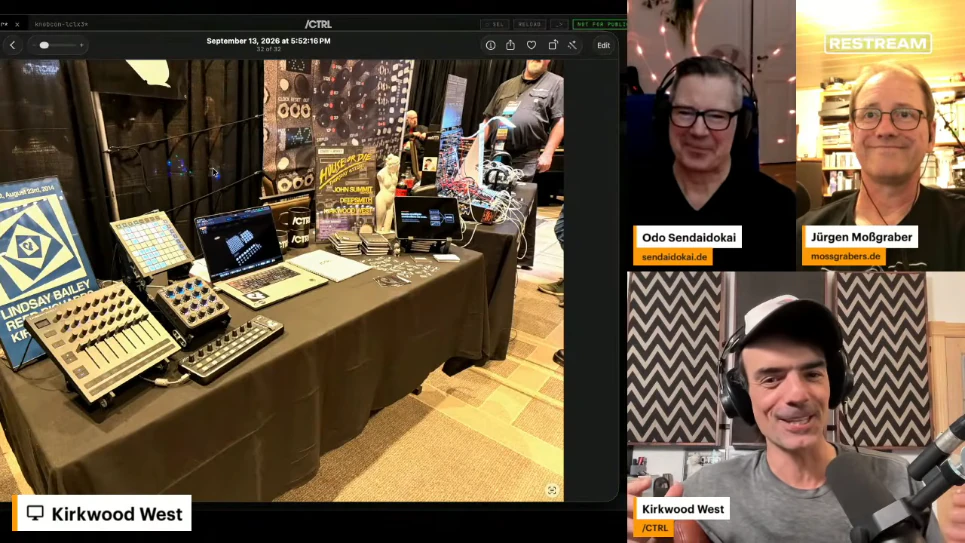
Jeff just got back from Knob Con https://www.knobcon.com - a really cool synthesizer conference in Chicago suburbs. Not a lot of big name manufacturers this year, but the coolest part is everyone is approachable. A little like Superbooth but less parties. Superbooth was wild - seeing the surgeon play or Robert Henke. Knob Con is more community-driven. His girlfriend helped set up the entire booth - shout out to her. She made a little video of the program. Jeff’s first exhibit at Knob Con was a success.
Music
As a producer, Jeff makes slow techno and minimal music. He has his 909s, 808s, and is obsessed with VST emulation - D16, Audio Realism, Bitwig’s stuff. What he’s not happy about in Bitwig right now is putting in sequences. He is working on the sequencers with /CTRL to make that process feel more like the Cirklon.
His music is minimal - a couple drum patterns, maybe two synth patterns, everything else is modulation. He has a separate bus that records all the audio, and he plays live into that bus. Then he ends up with a big blob of multi-track. His music is experimental, improvisational - parts can easily be moved around without sounding weird because there aren’t a lot of key changes. It’s minimal - you can transpose pieces anywhere. There are no rules.
Bitwig-Studio
One thing really cool about Bitwig is the bouncing feature. If you make a clip, you can bounce it and deactivate the original audio. You still have the VST there, but it’s hidden. Now you have an audio clip ready to go. The workflows in Bitwig are so nice - from the browser to your final track, your two-track audio or multi-track STEM. Another thing: the latency DPC when you have nested sends and buses - all the effects feed into the next bus.
The Squirrel
His friend Randall Turner is the super engineer - writes assembly and fixes really low level game code. They were going to lunch and Randall said, “Where’s Squirrel Boy?” His friend Nate asked, “Who’s Squirrel Boy?” Randall said, “The squirrely guy.” Then Jeff showed up and Nate was laughing. Randall was calling him Squirrel Boy. That is the origin of the squirrel.
Sources – Kirkwood West (Jeff Kirkwood)
Personal / Direct Profiles
- Official Website – Kirkwood West https://kirkwoodwest.com/
- /CTRL — Modular Bitwig Extension & Control System - https://slashctrl.io/
- Kirkwood West – Bitwig Certified https://www.bitwig.com/certified/kirkwood-west-65/
- Kirkwood West on Bitwig Community (Mastodon) https://social.bitwig.community/@kirkwoodwest
- Instagram – Jeff Kirkwood (kirkwoodwest) https://www.instagram.com/kirkwoodwest
- Bandcamp – Kirkwood West https://kirkwoodwest.bandcamp.com/
- GitHub – kirkwoodwest/Bitwig-API-Utils https://github.com/kirkwoodwest/Bitwig-API-Utils
- GitHub – Initial commit (Bitwig-API-Utils) https://github.com/kirkwoodwest/Bitwig-API-Utils/commit/fb56d82
- GitHub – Same Haircut (Bandcamp) https://samehaircut.bandcamp.com/album/time-future-love-space-preview
Forum / Community
- KVR Forum – Launchpad Mini Mk3 – Performer – 16 Assignable Track Clip Launcher (Pre-Release) https://www.kvraudio.com/forum/viewtopic.php?t=610941
- KVR Forum – Controller LED with k2 Allen & Heath in Bitwig https://www.kvraudio.com/forum/viewtopic.php?p=9102278
- KVR Forum – Bitwig MCP Server https://www.kvraudio.com/forum/viewtopic.php?f=268&t=619357
- KVR Forum – Bitwig Plugin Window Control https://www.kvraudio.com/forum/viewtopic.php?t=590095
Public / Media / Databases
- LocalWiki – Kirkwood West (Champaign-Urbana) https://en.localwiki.org/cu/Kirkwood_West
- Beatport – Kirkwood West – Artificial Barrier EP [Subtrak] https://www.beatport.com/de/release/artificial-barrier-ep/203366
- Smile Politely – Hydrogen (2013) – Serving it up Slow & Low https://www.smilepolitely.com/music/serving_it_up_slow_low/
- Bandcamp – Same Haircut – Time Future Love Space (Preview) https://samehaircut.bandcamp.com/album/time-future-love-space-preview
- The Pawn - https://msmemorial.if-legends.org/games.htm/pawn.php
Timetable
Click to see the Timetable
[00:00:00] - Introduction and Welcome
[00:00:30] - Greeting Jürgen (Moss) and Introduction of the Guest
[00:00:55] - Meeting Jeff Kirkwood: KVR, Discord, Superbooth
[00:01:21] - Jeff on Moss's Tutorials and Learning Java
[00:03:07] - Jeff's Location: Fairfield, Iowa
[00:03:36] - Small Town, EDM Community, High School DJs
[00:04:03] - Early Influences: EBM, Front 242, Skinny Puppy
[00:04:30] - Connection to Chicago, House Music, Record Collector
[00:05:00] - Drum and Bass Obsession, Imported Records from the UK
[00:06:23] - The Beatbox Youth Club, Breakdance and DJing
[00:07:21] - Basement Parties, Best Western Ballroom, Early Live Sets
[00:09:38] - Flyers, School Dances, Torturing Everyone with Drum and Bass
[00:11:05] - Amiga, Trackers, Prodigy "Out of Space", Love Parade
[00:12:59] - Recording from Radio, Tapes, Sharing Music
[00:14:26] - Edytape, Spotify Algorithms, Lost Feeling of Discovery
[00:15:24] - Newer Producers Not Knowing the History of Genres
[00:17:52] - Jeff as a Programmer, Live Performance as the Goal
[00:18:18] - 90s Laptop Setup, Ableton, DX7 Clip Launching
[00:20:09] - Right-Click Mapping Pain, Precursor to Controller Software
[00:22:34] - Hardware Journey: Moog Rogue, Juno 106, Jupiter
[00:24:31] - Mixing Desk, Behringer, SysEx Integration in Bitwig
[00:25:23] - Compact Live Setup, Squarp Sequencer, Lemur and OSC
[00:26:21] - ClyphX, Ableton DOM, Bitwig's Different Approach
[00:29:19] - Controller with Stiff Knobs, Mini Version, 10 Knobs
[00:30:43] - Channel Strips, SysEx Specifications, Older Controllers
[00:32:10] - Wooden Stands, Topper Desk, Ergonomics of Synth Control
[00:33:39] - Japanese Rule, Room for New Ideas, Rearranging as Part of Music
[00:35:30] - Boredom Boosts Creativity, Synth Meeting with 15 People
[00:38:38] - Why Jeff Switched to Bitwig: More Than 128 Parameters
[00:40:55] - Richie Hawtin, Mapping More Than Eight Parameters
[00:42:21] - Bitwigs Help with Controller API, KVR Audio Community
[00:43:49] - Multiple MIDI Inputs, OSC and Controller Together
[00:45:41] - Hardware Lab, Big Knobs, Open Source Plans
[00:46:35] - 3D Printer, Arduino, Fusion 3D, AI Workflow
[00:48:36] - Soldering, Analog Rytm Screen Replacement
[00:50:50] - KnobCon, Community, Bitwig T-Shirt, No Booth
[00:52:43] - Secret Mission: More People into Bitwig Studio
[00:54:12] - At NAMM, Heavy Backpack
[00:56:03] - Elevator Pitch: Modular Controller, Dynamic Behavior
[00:57:30] - OSC Window, Visualizing Knob Assignments
[00:58:57] - Kirkwood West, JSONified Controller Engine
[01:00:19] - Controller Drivers, Akai APC Mini MK2, Launchpad SysEx
[01:02:14] - Walkthrough: Launchpad Mini, Bitwig API Objects
[01:05:39] - Layers, QMK Editor, Push and Pop
[01:07:37] - Visual Editor Dream, Callbacks, Watching Elements
[01:09:43] - Generic Flexi, Prompt Engine, Clip Launcher State to Color
[01:11:38] - Controller Library, Remote Testing, Manuals Are Wrong
[01:13:03] - AI Research, 80% Solution, Claude Stopped
[01:15:53] - Moss on AI: Saves Months, Makes You Crazy
[01:16:47] - Driven by Moss Reaper, MIDI Ports, Lock-Free Synchronization
[01:18:08] - C++ Layer, Replicating Bitwig API in Reaper
[01:20:29] - Browser Bugs, Favorites, Remote Control Mapping Deletion
[01:21:28] - Bitwig Hacking, Native Plugins, Patching Bitwig
[01:23:25] - Ableton Code Conversion, TOS Violation
[01:25:05] - API Maintenance, MIDI 2.0, CLAP Plugin Idea
[01:27:49] - UI Customization, Orange, AI-Generated Interfaces
[01:30:30] - Certification, Sandbox, Apple vs Linux Way
[01:32:55] - Patreon, Free Extension, TouchOSC Templates
[01:34:52] - Manual, One-Person Project
[01:35:23] - Saints Row, UI Design, Bitmaps, Drug Paraphernalia
[01:37:08] - Building a Tool for Designers, Making Tools for Artists
[01:38:01] - Squirrel Boy Origin, Randall Turner, RTO
[01:39:30] - Game Audio, Wwise, Reverb Volumes
[01:40:26] - Atari ST, The Pawn, Zork, 512 Colors
[01:42:15] - Jeff's Music: Slow Techno, Label, Software Focus
[01:44:10] - Eight Drum Channels, Four Synths, Megabus, Browser
[01:45:32] - Cirklon Template, Quantize, Loop Building
[01:47:09] - Experimental Improvisational Music, Audio-Only Workflow
[01:48:52] - Nested Sends and Buses, New York Compression
[01:50:48] - Ableton Project Import, VST Settings Recall
[01:52:14] - Bitwig vs Ableton Feel, Knob Behavior, Acceleration
[01:54:37] - Softube, Knob Snapping, Controller Flexibility
[01:55:58] - Elektron Buttons, Activate on Release, Hold vs Press
[01:57:54] - Recording Multiple Clips at Once, Control + Click
[02:00:29] - UI Workarounds, Modulator Presets, Missing Polish
[02:01:28] - Bitwig Sampler Update, Vintage Sampling, Amigo Sampler
[02:03:54] - Learning by Crashing, Permission to Fail
[02:05:15] - Chat Questions, Shipping /CTRL, YouTube Channel
[02:06:13] - Rust vs C++, Java, Scala, Traits
[02:07:37] - Donations, Playlists, Community Channel
[02:09:52] - Thavius Episode, Spotlight for Creators
[02:11:35] - Women in the Community, LA Workshop
[02:13:31] - Next Episode: Nicola Grigatti (Psy-Trance), November 15th
[02:14:51] - Odo AI Music Live Stream, Encouraging Beginners
[02:16:43] - Childhood Trauma T-Shirt, Jürgen's Projects
[02:18:09] - Last Words: "Don't Take Defaults as the Standard"
[02:19:47] - Thank You, Leave Comments, See You November 15th
[02:20:12] - Goodbyes and End of Stream
Transcript
Click to see the whole Transcript
Bitwig Community Talk – Episode with Jeff Kirkwood
- Hosts: Odo Sendaidokai (starting), Jürgen Moosgraber (Moss)
- Guest: Jeff Kirkwood (Kirkwood West)
- Total length: 02:20:27
Introduction and Welcome
00:00 Good evening altogether. We are back now in Bikuta, the Bitwig Community Talk. And if you don’t know about Bitwig Community Talk, we are just a community, a podcast who try to talk to very interesting people you should know about. And with me is Jürgen Moosgraber called himself Moss, the big inventor of Driven by Moss, Convert with Moss and a lot of other cool stuff.
00:30 Hello, Jürgen, how are you? Hello and good evening. I’m very well, thank you. And hello all around the world, wherever you are located. And we will talk all things Bidwick tonight and as well latest versions. And we always have a great guest. Oh, yes. You brought somebody with you?
00:55 I brought somebody, not with me, but we have him connected via internet. So we have to there tonight, Jeff Kirkwood, and I met him already on KVR a long time ago. And he always giving good tips as Kirkwood West on KVR. And I think you’re on what’s the other thing, Discord as well? I’m on Discord all the time.
01:21 We met in person on Superbooth this year in Berlin and this was really, really fun. We had great time at the Bitwig party as well and it was a long night and I stopped talking about that. So welcome Jeff to the show. Cheers guys. Really happy you’re here. No, I’m stoked. I Moss has been, I’ve been like following Moss and like trenching through his code and…
01:45 learning everything I can about bigwig extensions from Moss. So it was like super exciting to see him at super booth. Cause basically it got back into programming because of these lights. I think he said something like, you should learn Java. I’m like, and I’m like, how do I learn that? Like, can I learn from you? I’m like, and obviously crickets Moss is very
02:15 Works very hard in this extension without, yeah, I don’t know, without a lot of, I don’t know, direct support, I should say, but the tutorials helped out and they’re phenomenal. That whole series covers the whole extension, how to do everything. Okay, stop it now. Yeah. I mean, it’s true. mean, they’re phenomenal. You have to take that, Jürgen. You have to take it. Just listen, you know. I don’t think I would have gotten in, like honestly, the…
02:43 the initial framework and just getting set up in the Bitwig API is fairly challenging. And without knowing where to go in the controller host and in it, how to set up, how to even set up your Java environment, you can debug in the Bitwig API. I don’t know, you cover all of that in your series. So, nobody else is doing it. So what’s the job to say?
Jeff’s Background and Location
03:07 So where are you talking from actually? I’m currently in Iowa in my hometown, Fairfield, Iowa. And it is, yeah, it’s a small town. It’s like a meditator community that moved. I think we took over this town in the eighties and yeah, I from California when I was three years old here. so I just came back. went to, had a hiatus in California and now I’m back. It’s kind of a…
03:36 I don’t know. I like it here. It’s chill. There’s like 10,000 people. It’s like small community. All my friends make EDM and that sounds great. It’s pretty cool. Yeah. It’s full of EDM people. Oh yeah. I think, yeah, like a 10,000 person town. And then there’s like, I think there were like 20, 20 of us were DJ in high school. it was like a
04:03 We were really into buying records and finding new records and sharing them with each other. was really fun. Great. So there was a lot of music or was it more like disco times? Oh, no. So my brother got really into like EBM and electric body music and taught me about Front 242 and Skinny Puppy when I was like eight years old.
04:30 And there’s always been kind of this like connection to Chicago. We’re about five hours away from Chicago. I think in the, in the nineties house music somehow got popular. People started buying records again and people were importing records from Chicago. There’s a town called Iowa city and there was a wreck. There’s a store called record collector and you could go there and buy records. And I was really into drum and bass. I was like, house music sucks.
05:00 We’re only doing drum and bass. I’m going to be the only drum and bass DJ in Iowa. so that’s what I said. There was they had like a small section for drum and bass and I would dig through there and I’d look for any. I didn’t know what drum and bass was like. There was I didn’t know what a label was. I just looked for any record that said Jungle on it. And eventually I went to the guy, you know, the guy who buys all the records. I’m like, well, you just point show me all the drum and bass records. And he’s like.
05:29 went through the, cause I think it was all mixed up with how it was all just electronic. he pulled off like suburban base records, metal heads. He pulled out all these like Goldie. I’m like, Oh my God, this is amazing. Cause I’m in Iowa. This is the nineties. The internet, nobody really has internet yet. And like somehow I’m getting records imported from the UK and the small little town. said, mate, this looks so cool. So I’d like save up all my money.
05:58 and go spend, you know, spend 10 bucks of record. imported, so that was imported records were like $10 domestic ones were five. It was like super cheap vinyl days, but like, yeah. So my records cost us double the amount of all my friends records. Cause I was jungle list. Um, yeah. What else? Yes. It got really, I was.
06:23 We were all DJs. It was wild. So when did you DJ? Were they youth clubs or? Yeah, actually, later, my friend actually started a youth club for kids because there’s nothing to do here. So we had started a youth club called The Beatbox and we go there and breakdance, DJ and I think it’s breakdance, DJing and I’m saying it was like hip hop oriented mostly, but we could spend electronic music and
06:52 They built a sound system, had a big breaking pad in the middle of the room. was in some basement underneath a gift card shop. And then it actually, he figured out how to get funding from Iowa and it grew. And he built a computer lab to teach computers. It was really cool. And then eventually it grew again and he had a full student of boxing and a big club room. So we’d do parties there too.
07:21 And then the other, on the other scenes you could like, you could get a bar for the night or there’s some, we do a lot of basement parties and houses around town. Cause that’s the only way you get away without doing a noise complaint. Like noise ordinance is bad. Um, but yeah, we were doing all that throughout the nineties. It was fun. Oh, we, oh yeah, we used to rent out the, there’s a hotel, there’s one hotel called the best Western and you could rent out the ballroom.
07:48 and do a party there. So we’re like 16 years old throwing these cool parties. Kids are sneaking in beer and like I’m logging. I was like, I got really into playing live on my computer. So I’d bring in my desktop computer and like press play on, on fast tracker or I think I was using buzz tracker at this time. It was, it was so cool. Yeah. We were having fun. Just like electronic. Nobody.
08:16 Where else are you going to hear electronic music other than at our parties? was just a small handful of us doing it. one thing we couldn’t tell is, are they there because there’s nothing else to do? Or are they there because they like electronic music? There’s probably a little bit of both. It was fun, learning how to dance and just being part of the party. It’s very interesting. We also did insane things like that back in the days.
Early Party and Club Experiences
08:46 We did concerts on the field, nowhere in the field, with maximum of 500 people. There was no security, nothing, anything. That’s pretty big, And we did one, yeah, was only with friends and, oh my God, fingers crossed nowadays. And we did one thing in a hall.
09:11 There was also, know, we just asked the local club, they are, can you do the drinks? Yeah, sure. They did that. And it was also a packed thing. don’t know, five, 600 people, no security, nothing, you know, you couldn’t do that nowadays. It’s impossible. just worked back then. That’s so cool. mean, I like it’s like, this is new. It’s exciting. Everyone’s showing up with their best interest in mind and you’re promoting it. Like I would stay out outside of school and like,
09:38 I’d print up a bunch of flyers, Xerox, a bunch of things and just pass them out and the whole school would come. It was so cool. mean, like you can’t even get somebody’s attention to look at a piece of paper. It’s like 2026. like, what? It’s on paper? What is this? I’ve never seen paper before. My first gig was actually in our local school in front of all the kids, you know, and they totally went nuts.
10:08 We were as as a band could be. It was really horrible, but they went nuts. What kind of music were you playing as Rock covers, first own songs. We would take over the school dances and I would torture everyone with drum and bass for an hour. I think our sets were 45 minutes because we didn’t have a long time at the high school dance. We’d have hip hop, house music and I would torture people for it.
10:35 Teach, not torture. I think it was torture. I don’t think I was that good at DJing. yeah, I don’t know. It’s interesting. was cool to be able to play. It was an awesome opportunity for me because I was like, this is so cool bringing these records that nobody gets to hear. can’t, there’s no spot, like there’s no, you couldn’t even get it on CD if you wanted to, a lot of these records. So I think that, that culture is really cool, especially back in the nineties.
Early Electronic Music Influences
11:05 Absolutely. When everything started, it was sometimes a bit hard to find other people. was growing up in a village too. And because I saw that in the chat, were Amiga times, I had an Amiga and I was also on some tracker stuff. And this was like so crazy for me. Then the whole jungle and drum and bass started and I had the Prodigy single, like what is this? Out of Space, something. And that run like two months in a row.
11:35 I never stopped that singer. Maybe I crashed the CD player. don’t know. But this was so crazy and I was rocking hard on only that one song then. But that’s all you had. Like you couldn’t go to the store and just get like more. you’re like, well, this is what I, mean, one that’s expensive CDs are like fairly expensive. And then you’re like, I can’t get more of these. So this is what I’m going to listen to. Like, I don’t know. I’ve listened to experience.
12:04 thousands of times, like same thing. had it on tape. I just like, I can’t get enough of this. whenever, I like that weather experience would come on, it’s like with the storms, I was like, yes, weather time. And then it’d be go into the, in the jungle and like, yes. Yeah, yeah, yeah. It’s just like, and then we want like turn over the tape and start all over again. And that’s like out of space. Yeah.
12:31 So great that time. But I had the luck that in that time the love parade started a little bit later, like 91, 92 or something. So whole Germany gets a more electronic music and the radio station as well. So that was my luck. So I got at least from outside and more and more people started listening to that. And so we exchanged like tapes and stuff.
12:59 And that was really great start. Yeah, because you’re recording it on the radio, right? And then just passing, oh my God, if I could only record good music off the radio, like impossible here, at least in this village. Yeah, nowadays, nowadays there’s not so much left anymore. Yeah, it’s kind of like back then, it always felt like a discovery and I’m always finding something new and I’m able to share it with my friends. don’t, that feeling of discovery is
13:29 It’s definitely changed now. you, I, yeah, I don’t know how that feeling. I would love to figure out how to get that back. It’s so good. I I think, I think it’s still there in a way, but because a lot of people are on some platforms with some algorithms working, but I still ask a lot of people like in a community around and say, ah, what’s, what’s your music? What, what do you like to listen and hear and their people then suggest some music. And that’s what I still like.
13:56 and I try to encourage people to do that. Just, you know, talk about what you like about music, if you encounter something new. Because lately I encountered a Korean band like Edytape. Crazy, I love them. I think I sent you the concert from yesterday evening, Jürgen, or something. You just told me the name, but you did not send it. I didn’t? Oh, I will send you later. But I love them. They are just crazy doing crazy stuff like live EDM.
14:26 It’s really, really great. And kind of that, I sent you the link in the chat so you know. Excellent. I think that’s important to share music and because right now, you don’t need to share music. It’s not a requirement anymore. You can literally just walk into Spotify and I’ll guess your mood. Yeah. And then you’re like listening to something that just goes, it’s just like.
14:54 crosses your brain barrier to your ears to your brain, and then it’s like completely forgotten. That’s interesting. And like all those, I don’t know if I was a new kid and that was my access. I don’t know if I would remember all these like unique labels and identities. And I don’t know, they’re pretty important. Like those early musicians like the Prodigy and I mean, go into the list of legends.
15:24 for electronic music, Goldie, and just the impact they had on sound. And then like I meet newer producers today and they say, and they’re like, oh, I’m making drum and bass. I’m like, well, do you know where drum and bass comes from? what is drum? Like, do you know what a break beat is? I’m like, yeah, I know what breaks are, but like, do you know that like that didn’t exist like before this time? And like, and who, who really pioneered that, that style of sampling? That’s interesting. Like that.
15:53 It was one thing I was asking this kid was like, he was like making trance and I’m like, well, do you know who John Digweed like big trance DJs? I think he knew what Tuesta was, but Digweed or like Paul van Dyck, like pretty big trance people that like, in a way like pioneered like the explosion of it. Right. And just to not know that it seems so like disingenuous to like, well, it’s just trance. Well, nobody.
16:23 the term was like coined by a group of people. It’s weird. Do you think that its ownership changes from just, it just becomes a genre and it’s like this public thing that evolves or is it like, I don’t know. It’s something I’ve been thinking about and something I want to like, I think we need more people talking about the history of this stuff because it’s important. I think it’s important.
16:53 Yeah, absolutely. It’s new. mean, it’s so new to like dance music is new. Like electronic music is relatively new. Like, what’s it going to be in a hundred years? Is it going to even like that’s weird, right? Like, like even rock and roll is pretty new. Yeah, kind of pretty. It’s pretty interesting that I kind of wonder what it’s going to be like in a long time from now when we’re
17:22 I hope maybe we’ll see it when we’re in 40 years. We’ll still be alive. We will. will. a technical technology. So DJ and did you also learn a Broadway instrument called like that? I never got to learn as a DJ. I see myself more as like a programmer. That’s what I see myself like. I like to program music and
Jeff’s Approach to Music and Live Performance
17:52 I like to play live. That’s my favorite thing to do is like bringing a setup, figuring out how I integrate with it and what I can control and what I can shift in a live performance area. I really like bringing my own tracks in and like, and like messing with them live. That’s kind of what I really like doing. So I’ve been doing that since the late nineties. I bring, I used to bring my laptop out and, not my.
18:18 No laptop. picture of that little laptop you have there. I’ll share the photo of me. Is it screen sharing? Yeah, no, it’s sharing. OK, cool. is laptops looked in the 90s. This is how laptops looked. This is a New Year’s Eve party, so I’m all dressed up. I think I ended up taking off my shirt. I went maniac on this.
18:48 You can kind of see in the corner here there’s a there’s an MCRA stacked on a DX7. oh, I think for this one I used Ableton one or two. I had some cracked version of it that I had. Yeah, I’d load up my 90s. no, is this is 20002003. OK, think 2002. Yeah, OK.
19:13 And so I’d export, I eventually like learned how to use Reason. I got over trackers and then I would just export all my stuff, master it in T-Rex and then have like stems that I’d drop into Ableton. But I hated it. Like I’m always clicking the mouse to launch clips. I think I figured out how to like map some things to the DX keyboard so I could like launch clips from the keyboard. But there’s only like 64 sets of keys. So that’s only 64 potential keys.
19:42 scenes you could launch and there’s no like tools like you didn’t have a push you don’t have like a push or a launch control back then so you’d like just do with what you had and that’s so that’s what I was doing I was launching clips from my dx7 I think I would like even drag and drop new scenes into the same clip slots so that I could keep the mapping the same
20:09 This is kind of a precursor to why I’m really interested in controller software. Cause it’s most of the time it’s just been a pain in the ass. You like right click on everything to map it and then, and then stuck in that permanent position and it’s only exists for that one song. So, so you started since, since the beginning always to make things more fitting into a practical environment. Yeah, yeah, absolutely.
20:38 Or at least just to avoid having to like do a whole, like one of my other goals is to like make it so when I’m in my studio and I, and when I finish a song, it’s already, it’s, it should be ready to perform live. That’s what my, that’s what my super dream is. Like just being able to like move a song from a studio setting into live without doing a lot of work. So if the studio and live thing are essentially the same thing.
21:07 then that should be possible. We’ll see. We’ll see about it. So your whole workflow was all the time towards playing live, not only creating music and maybe, so it was always like the goal that this could be, this should be a presented life. A hundred percent. mean, I think that’s like, that should be the goal. Otherwise it’s just like a studio micro edited thing. that somehow.
21:35 never fully interests me. I think you can do a lot in that format. Like your output is supposed to be a two track 24 bit wave. And then you figure out how to get there. Like Fortet works like that. He does like work and cool edit and just like stitches a bunch of stuff together. I don’t even know if he uses a DAW for some of us. Like I guess cool edit has multi-track, but like it’s not really designed to make electronic music.
22:05 per se like Ableton is where it’s like all be gridded out and the tools make it really easy. Yeah. But my issue with that is like you’re in this like spreadsheet environment and you’re cutting up cutting up spreadsheets. I’ll show you some more more photos from my studio. So this is this is after. So I was doing computer like music in the box forever. And then some my friend was like, you got to get a Juno 106. You got
Hardware and Studio Evolution
22:34 you got to get some hardware. And I’m like, okay, so I got this Moog Rogue. I’m like, this is pretty cool. And then I got this Juno 106. That’s pretty cool. Like they just, they sound different. And I didn’t really understand the differences between like an emulation, like the subtractor synth and reason versus the 106. They all have the same knobs and everything, but these have a unique sound that their oscillators are different. The filter chips are all different.
23:04 And I got really deep into it and was just trying out a bunch of stuff. I still have the Jupiter and the 106. They’re probably my favorite synthesizers. Got a DX7, a TX7 down there. Can you see my mouse? Is my mouse? Yeah. Yeah. Cool. Yeah. And then we have a little, think, ESQ1 over here and then a little Octatrack Trio machine, the Mono machine. Those are really cool sequencers. They’re like really fun to use.
23:33 I don’t know, I still wanted to be in the box. Like this wiring, like you can see in the background, there’s all these wires and I have another photo with, I just hate wires. Do you have still all these synths? I have the legacy ones. I got the ESQ one, the JUP6 and the 106. I think, and I’ve lent a lot of them out. Like I think my friend has my Vermona mono synth. I still have my delay pedals cause I like DJing with those.
24:04 Oh, there’s the DSI Tetra. That one’s wild. It’s cool to take pictures of your gear and then see what happens 10 years later. We actually put it. think it’s interesting for me to see some of my old setups. This is my mixing desk, an old MPD, the classic Behringer’s. Back in the day, there still wasn’t a lot of software.
24:31 designed to map with these. yeah, when I started integrating these into Bitwig and there’s so much you can actually do with SysX and like pushing, you can update all the knobs in real time and parameter, like it’s pretty impressive. Those are still the beasts of MIDI controllers. And then I was like,
24:55 got to then I wanted to play live right so I’m like how do I make a compact live setups so this is my quote unquote compact live so it’s a compact one with a little mixer on the right yeah with that real small mix little me yeah I figured like you’d have to get that you know they book you for I don’t know $100 and then they rent a mixer for $300 so you can play
25:23 I had a, I got the Squarp sequencer. That’s a really cool sequencer. yeah, I’ve got all the, this is like compact stuff was just coming out when I bought this. So we had the, the, the cool boutiques, but there are only four voices. And I don’t know, this is actually pretty fun to play on. It was just still, I’d rather be in the computer somehow at that, at that point. So I kept on like experimenting. learned a lot about lemur and OSC.
25:52 So I built these templates that would control my Ableton devices. These are, let’s see, yeah. So they’re like mega templates and I set them up all on a rack and I’d have my, I bought a Cerclon, one of my favorite sequencers and I control Ableton Live with OSC and some MIDI stuff. I think I was using Clifx at the time. They have OSC enabled.
26:21 to do bindings back and forth. there, Clifx is, do you guys know a little bit about Clifx? Yeah, yeah, we know what Clifx is because he are creating spaces. He joined the chat too and he created something for Bitwig like that. Yeah, yeah, it’s really cool. Yeah, yeah, I’m in touch with him. He’s doing really cool stuff there. It’s a complex project because like Clifx, if you know anything about Ableton, it has a DOM, document object model.
26:50 So you can pretty much access anything in the program at any time via their controller extensions. And Bitwix kind of set up differently. You had to set up all these objects and then you can do stuff with them. yeah, Bidax is pretty cool because he’s built a compact thing that you could like mod into your existing controller. Again, you’d have to know Java. I’ve the chat I just saw. Oh, word. What up? How’s it going?
27:20 Yeah, yeah.
27:25 Yes, he’s the man. No, he’s cool. like, he also plays live, which is like, this is so cool. I like people that play live. think that’s important. So I was experimenting mixing on with hardware and stuff. And this is my cat. I’ve got a little bed up there. This, I brought this rig out to a spot in San Francisco called, it was used to be called the top. I think it’s SF underground played live there. That was really fun.
27:52 But Ableton, so I’d use Clifx to recall all the, I basically made a set that had like locked, let’s describe this with this. So I made a set that had like a drum machine and like locked in synthesizers. And then I could like recall all the parameters with one button using Clifx, because it has this cool recall technology. And so I was able to switch songs while I’m.
28:21 basically playing live, accomplishing my dream. Like I want to be able to DJ my own music and play the songs in real time. So I had a way to like transition. had a way to like resample the existing song, cue up the next one, flip the loop to like the looped version, and then start fading in parameters from the new song. And so I had this like continual, like, I don’t know, rolling live set. So like,
28:50 constantly evolve like I’m DJing my own music. Oh, nice. Yeah. What else? This is the little, I like to do some of these so I know what goes in the bag. You got to have that. This is what happens after the bag. Yeah, I was experimenting with this controller. You’re familiar with this Moss is the, it’s a cool controller, the touchscreen, but like
29:19 Somehow the knobs were like really stiff and I guess like could have like opened them up like like Euro did. Did I say his name right? He like regreased his potentiometers on his custom MIDI controller and then made them less stiff, but they didn’t do that. And I don’t know, there’s something about the controller. just didn’t gel with it. There’s so much configuration that you had to do. I think your script was probably the best thing out there for it.
29:48 Yeah, it’s happening a lot. is now this smaller version, the mini. And yeah, the mini actually much more than the bigger one. Oh, cool. Because you can push the buttons as well. even if it’s simpler, it’s more logical to use. Yeah. Yeah. It has 10 knobs. I think this one, it could probably be eight. You know, I’d like to have physical switches. This is these little gel switches are kind of dumb.
30:17 There we go. That’s a better photo of it. What was I doing here? I was probably configuring every single… Yeah, I was trying to make… I’m really interested in channel strips for mixing. So just having a channel strip that I drop on and I can see everything right there. Kind of like the soft tube stuff. They do it, but then they restrict it just to their platform. So I’m anti that.
30:43 Like I want to, like some of the stuff should just be like open to some degree, you know, like that’s the controllers that publish their own SysX, the whole SysX specification. That’s where things should go. Cause then you can, anybody could connect it to their devices. It’s not restricted in some crazy old platform. And we have all these older controllers that you can’t do anything with. Cause the software it was designed to control doesn’t exist. A lot of instrument stuff is like that.
31:12 You have like a machine, MK1s that are just like sitting there collecting dust. I think this is me mapping the OPX, one of my favorite OBX synthesizers to lemur. used, I was really big into lemur. This is another lemur template, live rig. This is me in the studio. My friend Miles only works on analog gear.
31:41 pre 1990. So his like whole besides his DAW, he and his like excellent converters, he’s like all vintage stuff. So he’s got like ARPs and Moogs and I could go on. I’m not giving it the, I don’t want to blow up his studio scene. His gear list is great. And I just like over the years I use
32:10 built all these stands out of wood and they’re really easy to make. So I’ve like made hundreds of these different stands, hundreds, probably about, probably about 25 of those stands. Cause I’m like, well, these should go together like this. And then I would like change it to another, another format. And yeah, I’m trying to find if I can find more of these. Yeah. This is more custom stands I made. Yeah. I have a lot of built a lot. That’s a wide one.
32:40 I built this desk. This thing actually like slide. This is a, I call it a topper. put like sliders in there so could pull it forward. So it fit like right against the wall and stay compact. I don’t know. I’ve like really into ergonomics of synth control and the only, and I think ergonomics are like very personal and you kind of have to iterate on them quite a bit before finding what
33:10 you like, or you just keep iterating and that’s that part. I wanted just asking, there, is there any way an end to not change it? Because I, I don’t have much space here, but I just keep iterating. I well, cause it’s, keeps it fresh. Like it’s like getting a new plugin all of sudden, or like a new scent all of sudden, like, like making music again. This is cool. Like that, that part’s helpful. I think changing it up. It’s like.
33:39 Like every once in a while I’ll change with my bedroom layout and all of a sudden I have like more energy. Like something fresh in the mix, I think is important. So maybe, I think maybe there’s like a Japanese rule about like not filling up your entire bookshelf with stuff. So you have room for new books. So you always have some.
34:07 But the idea is to always have room for something new to change. I’ve always thought maybe on this setup, example, maybe this is not the best photo, but there’s one, this one. This part would always change with some different hardware that I was trying out. Maybe some things would always remain the same. I don’t know, it’d be so awesome to have one setup that would be the best.
34:34 Yeah, but but but if it’s like you said, you know, the rearranging is kind of a part of making music, even if you just rearrange your bedroom that has nothing to do with them, you know, your studio or something. But but but I can see there is something because if you change stuff in your life, maybe your music gets some new ideas, too, because you start maybe looking at things differently. So 100 percent. I mean, just go.
35:03 going out and having a conversation with somebody can inspire something like something non music related can inspire music or not doing just not doing music can inspire music. That’s super helpful. Absolutely. All of a sudden you’re like, Oh, now I’m I like, I like this again. Like I listened, I listened lately to a podcast and they were talking about how boredoms boosting your creativity.
35:30 So they said, if people are always busy, there’s no place. Like you said, maybe this Japanese rule, there’s no space. You can get new ideas. So you have to be bored from time to time totally like sitting somewhere or something. your brain gets more space or it’s open to new things. It’s absolutely critical. just last weekend, we had a little Synth meeting, just 15 people and was the middle of nowhere.
35:59 I did exactly that, just brought three sons and that was very creative. It’s just a little recorder and that keeps you going with new things and new ideas. what did you guys do? Were you having a jam with other people or is just you?
36:16 It was no, it was 15 people and we just had the usual thing you do drinking, talking, eating and making music. Everybody with headphones and in evening everybody could present something or two people together could present something and that’s. Oh, that’s awesome. How did you, how did you set that up? Cause like, those are things that like, I don’t know, people don’t think that they can just set up a meeting like that. Is that something you set up or some someone else? No, it’s a, we,
36:46 You might have heard we’re doing, it’s happening for many years already, this happy knobbing thing. And this, but that’s bigger, that’s about 50 people. And one guy went there, I think for the first time or the second time, I don’t know anything. This is great. I need to do that too. So he just asked around and there’s a wine grower there who has a little meeting room there. And she just asked, Hey, we wanted to do this thing and can we have it pretty cheap? Yeah. So we just.
37:15 Everybody had to pay 30 euros, you know, and then that’s it. And everybody brought their stuff there. We could set up called electricity and here we go. That’s fun. That’s nice. That’s perfect. So it’s actually not that much of an organization. know, someone needs to grab a room somewhere, electricity, light, and that’s it. Yeah. Yeah. And then you got to, you got to do the outreach and get all your friends excited about showing up and showing up and do something that they can already do at home.
37:43 Like, you know what I mean? Like it’s like, okay, I can go to the movie theater or I can just like stream this from my bed. Like, yeah, it’s, it’s a new world, man. So I think doing this, how was you mean? It’s good to be, it’s It’s good to get. Yeah. Yeah. Now everything’s in the house. It’d be, it’s just good to get out there and like have some real connection over the stuff, especially because it’s such an introverted activity. Like.
38:14 Yeah. I have this screen showing because one of the main reasons I moved to Bitwig is because they allow you to map more than 128 parameters. this is like my last lemur script. And then once I figured out that you could map a lot of parameters, I switched to Bitwig. Yeah.
Why Jeff Switched to Bitwig
38:38 There would have been actually my next question on the list. How did you get from Ableton to Bitwig? But I would never guess that the answer is it has more than 128 parameters. Yeah, that was it. That was the number one reason. And then I had to figure out how to access them. And I’m like, well, I was stuck in like Ableton Python world. And then I found your tutorials and then I did Hello World. like, and I was like, not this is during a time when I like I retired from doing game development.
39:08 Um, and I was like, I don’t want to do anything that’s super high tech or program or design. Like I was so done. Like I got a job like working on a cannabis farm and just like something completely different. That, so I could like focus on music and not do all this tech stuff. And then little did I know I had to start programming again. You failed.
39:33 I failed. It was awesome. Like it was such a good leader and I already knew how to do Java. Like I did, I used to do flash and I do, do like legit ECMA script, um, back in the day. So I was like pretty familiar. had some design pattern knowledge and it was cool to wake that part of my brain back up and, that do it for something that gave me more purpose. Like, okay, I can turn this light on on my midi controller.
40:00 And I can turn it on to the color that I want it to be colored. And then I can, and then I can change the speed of the knob whenever I want. I can, I can like reassign the knob whenever I want. Like that stuff is you just, people can’t do that without programming. So that’s kind of like, I, so I learned how to program again and that’s, and I like went deep.
40:27 deep, deep into the API and like, can we do here? And I found so much stuff. It was great. then you like, you posted a video. You showed my best secret is the how to map more than eight parameters, eight control knobs. It was great. So you’re- You know that already. Yeah, no, knew way well. So like, so I’ll tell a story.
40:55 Richie Houghton was like posting on his, like, he has a loop talk and he’s like, does anybody know how to map more than eight parameters that is, I’m like, oh yeah, it’s me. And it’s like seven in the morning. I’m like in bed reading that I’m like doom scrolling. And I’m like, yeah, I know how to do that. And then all of a sudden I’m like DMing Richie and he’s like, and we’re like talking and then he’s like, oh, let’s get on the phone. I’m at the, I’m at the airport. like, okay. So all of sudden I’m talking to like my hero, Richie Houghton.
41:24 And I’m working on a controller extension for him to do so he could map more than eight controls. It was fun. It’s really, really exciting. And the caveat to that is like, you got to learn how to do the threading for OSC is it’s multi-threaded. So you have to make sure to synchronize, which is a Richie Hawtin word. You got to synchronize the calls when the
41:52 You’re like mutating data between the OSC connection and Java. That’s- You know such words. Yes. Synchronized. Well, I mean, I’m so grateful that you made your thing open source because that one keyword was able, allowed me to make it not crash Richie’s computer. I mean, I was like up for days. It’s like, what’s going on?
42:21 I don’t know, is that Bitwig problem? And I was like, I think I even emailed Bitwig. I was like, I need help. What’s going on? And Bitwig never helps you with any controller API stuff. They’re like, no, we don’t answer those questions. And then all we have is the community on KVR and any open source repos to get knowledge from. I’ve done a lot. Yeah, it’s pretty wild. I’ve done a little bit open sourcing. I have my…
42:50 I made a remote control script that a bunch of people use to, it’s just to do right click mapping with OSC. So like you can map, you can map as many parameters as you want. think your extension does user controls as well, but it’s, is it 16? Is it limited to 16? Moss? You might not remember. the OSC. Everything is eight. will see you.
43:19 I think you can configure it, but I’m not sure. Yeah, somebody was just messaging me and like, I need more than the, than this. I’m like, okay, we’ll make it 1024 or as many as you want. You just set the number. So it was just, which is interesting in Bitwig is like, can just, there’s these like functions to call and you’re like, Oh, I want a track bank of 16 and I want five track banks. can, you can do that, which is pretty phenomenal. You can.
43:49 set up multiple MIDI inputs. So you can have like three controllers working together. Yeah, that’s what really turned me on and actually doing, hooking up OSC and a controller together was my most favorite experience. So that’s what you’re seeing here on this screen is my controllers with my custom OSC controlling a Juno 106.
44:16 And then from there, I like touching on the screen and then clicking on a knob. And then I have hardware control of that knob. Cause I, there’s something about the touchscreen. I don’t think any controller will ever defeat that. I don’t know. Like it’s just a interface for, for doing synth editing. It just really is. because, because you can, you can draw with your fingers.
44:45 You could grab any parameter, just grab it and move it. And you can do multi-touch. OK, yeah. But it’s somehow not really fun, isn’t it? It’s nicer to turn a knob. It’s nicer to turn a knob. So it’s just having a little bit of both. You map that cutoff knob and you’re to the races. You only need the big cutoff knob. Yeah, you need a big knob.
45:15 Yeah, I think that’s important as to how you know that it’s always like, real DJs do it. I think that guy, Stefan Bodsen, he made his own MIDI controller and it has some big knobs on it. Yeah, the transparent one. Yeah, that’s like what I saw.
Hardware Lab and Future Plans
45:41 When I’m, I’m working on some designs. I’ve built a, I built a little lab. This is my, this is going to be my hardware lab and some working on sun designs. I’m going to, I’m going to take, um, euros and I can’t, I’m going to mess up his name again. Uh, but his control. Yeah. His controller and, who was the other guy again?
46:08 that was on the podcast before me. Gero and Stefan. Stefan, yeah. So I wanna take their controllers and make them big knobs. That’s what I wanna do. And also open source it. That’s like a really cool open source thing. I think controllers are like, they’re pretty cheap and expensive to make now. Like if you wanna make something custom, you can go pretty hard.
46:35 It’s impressive what you can do. So are you in electronics and all those 3D printer stuff? I just have, yeah, I have a 3D printer and then I’ve only done a little bit of Arduino. I think I’ve hooked up like four pots at once and I don’t know, the microcontroller programming side is more interesting to me. And I cludge around in Fusion 3D and
47:06 Yeah, I’m pretty slow, but I get, I moved through it, you know, like that’s like anything that like, this is the hardest part about a lot of the stuff is like, well, I only, I only do it once, like doing controller extensions. was hoping to only have to do it once. And then I would never think about it again, but I ended up just keep doing it over and over and over again until I got good at it. So maybe that happens here too. But that first time is always a struggle, but now we have AI, it can
47:36 you just prompt and it’ll tell you the next steps and then they’ll be wrong. And then you’d be like, well, at least I tried something. And then you keep trying and eventually you get there. I think that that workflow is pretty useful right now. And then trying to dig through any information on the internet’s really challenging at the moment because Google turned into AI. So, yeah, I don’t know. So this is definitely half learning and
48:05 And my, my, my roommate is actually a electronics guy too. He builds your Iraq and power supply boxes for. That’s a source of information to go to. Yeah. That’ll help. I currently have my octa. No, it’s my analog rhythm opened up. I replacing the screen, which is a nightmare to replace. Don’t ever do that. Cause you have to, the header boards are like soldered on.
48:36 Oh my god, I didn’t I never thought I’d put so much heat onto like a $12,000 or $1200 synthesizer. Just like trying to pull this pen. Do you guys do soldering at all? I would love to but I tried to stay away as well because it’s another rabbit hole to get into. Dude, I mean, all of a sudden you’re like
49:01 buying these tools and then you’re like, okay, and then I got to buy a 3D printer to print this honeycomb thing. mean, it’s weird how like, okay, this will take like a day to print and then it’s like, well, then it takes two days and then you’re like adding more to it and you got to find a model. It’s just a weird rabbit hole. don’t know. I’m glad I got into it for a minute, but it did take some time.
49:29 Yeah, I did that during the Corona lockdowns. So my wife has had access to a printer. So she brought it home and I could tinker with that for several weeks, but it’s, I know it’s not for me. It’s fun though. can. Yeah. I did everything. I printed all the star wars figures and shit, that’s amazing. Designed one thing on my own as well, but I forgot about everything. It’s if you don’t do that regularly, it’s.
49:59 Just too much. Yeah, exactly. Like getting into Fusion every time, I’m like, oh, I did this three months ago. Oh, damn it. I forgot everything. I mean, lot of modeling is pretty simple. Once you learn how to extrude and rotate the camera, you’ve gotten 90 % of the way there, I feel like. And then from there, it’s just like, I mean, that’s how I work in Blender as well as our.
50:27 Yeah, can’t recall. That’s the exact correct comment for that. Don’t be afraid of the four hours it takes to start a three day printing. These seven days will be the best four years of your life. Oh my god. It’s like that. That is the best quote ever, dude. Wow. That’s so true.
Knob Con and Bitwig Representation
50:50 Well, and then I guess, yeah. So what’s next? So what should we go for next? I said you already teased so much. now. Yeah, so I just I just got back from knob con last week. is all yeah. No, come. Yeah, it was a really cool synthesizer conference in Chicago on the suburbs. And there weren’t a lot of big name manufacturers this year, but
51:17 Okay. The coolest part about any of these things is like, there’s, they’re like, everyone is kind of like us is like, really into synthesizers and everyone’s pretty approachable and nerdy and ADHD and into their own thing and autistic and just like, it’s, like, ah, fit right in. So, so kind of a little, little bit super poofy. Yeah. Everybody’s like, oh, nice.
51:46 Yeah, I guess there’s less parties than Superbooth. Superbooth is like pretty big. mean, I don’t it was wild to go to Superbooth and then see like the surgeon play or like Robert Henke. And I’m like, what the hell’s going on here? This is like mega. Whereas this is more community driven. So a lot of the people that come to the conference also end up playing at the show. So they do a show at night and
52:15 Yeah, my girlfriend helped set up this entire booth and shout out to her. She made this little video of the of the program. Yeah, it’s really it was really fun. There weren’t a lot of bitwig users surprising surprising to me. I’m like, why isn’t everyone on bitwig yet? Yeah, so that’s one of that’s kind of one of my secret missions is like, how do I get more what
52:43 things can I do to like get more people into Bitwig Studio? Cause it’s such a, it’s so rad. It’s such a good application. And I’m really excited to see what Bitwig offers next, especially. Did Bitwig have the booth there? No, they did not have one here. No. So I was somewhat, I wore a Bitwig t-shirt on Saturday. That was my representation. So you should get some money from them for that. Yeah. They should send me all the dollars Bitwig.
53:13 Yeah, and you’re the official ambassador then. Or they could just put me in touch with their API wizard. think I still didn’t get to meet Alex. I think he’s the API. That was the rumor. I would go around asking every Bitwig person, like, who does the API? like, Alex. I’m like, where’s Alex? He’s like, he’s not here. I’m like, damn it. And I was talking to the CTO and I’m like, oh my God, this is crazy.
53:42 It was, that was a fun, that was a fun weekend being at Superbooth. think meeting you and hanging out with some of the Bitwig people were certainly on my highlights. Yeah. Yeah. You, you, you really looked like you were totally flooded by impressions in there. It was wild. Yeah. That’s really cool. Yeah. Just, think, I think I got a little, yeah, I was there. I’ve, I have good stories and also hanging out with Lars. Lars is a, Lars is really nice. I try to.
54:12 So that was like the second time I’ve like tried to infiltrate Bitwig is like the first time I went to NOM in 2023 maybe. And I went down there, I brought my laptop, touchscreen, four MIDI fighters, and then I like went to their booth first thing in the morning. And I’m like, I’ve been like trying to connect with them and set up a meeting and they’re like, we’ll set up a meeting.
54:40 So I get there first thing, try to get this meeting set up and then I’m like, okay, we’ll come tomorrow. So I had this heavy, just a super heavy backpack already, all my stuff just in case. So I’m bringing it by the next day. And then I got to set it up and show it to them. And Lars looks at it he’s like, well, how are people, like people are gonna need all this to connect to Bitwig Studio with your software. I’m like, yeah.
55:10 So I’m like, oh, this is probably not a good idea. I got to figure out how to like compartmentalize the work and build it into something that like, I don’t know, something more modular. So that’s what I made control and started working towards that pipeline of being able to like bring your own MIDI controller and connect it in a modular system. Yeah.
55:35 Do you guys want to see? So you told me you’re at NOPCON, but I wasn’t aware that you’re actually exhibiting something there. Yeah, yeah, this is my show. Yeah, great. Yeah, totally. Yeah, I exhibited. This is my first exhibit. My girlfriend made all these cool cups. She’s awesome. She’s like, you need better swag. We printed up a manual. I have the official control manual. That was really cool. Yeah, the demos went well.
Explaining Slash Control
56:03 Okay, so we… Let’s start from scratch. you wrote an extension, controller extension. What does it do? Okay, well, let’s just show what you can do. in Bitwig, can set up… Am I sharing Bitwig right Before you show fancy stuff, give us a brief, you know, the elevator pitch. One minute. Elevator pitch.
56:32 I got to go to my website. I’ll forget. OK, first learning, you need to be able to do that. Wait, wait, wait. Honestly, does so much that it’s a bitwig API programmer at one level. At another level, it’s like pre-built API elements that you could combine really quickly without having to program a line of Java.
57:01 pretty much the goal. Let’s say the elevator is, I’m reading my text now, a modular controller for Bitwig Studio, build dynamic behavior, not static mappings. That’s like your classic GPT line right there. Build dynamic behavior, not like right click mapping. And then I exit that Bitwig’s project. And then I got a real right click mapping. I have no idea where anything’s mapped to. I have to look at this little mini panel that’s on the side. If I want to see what something’s mapped to.
57:30 I don’t know how many times I’ve opened up a project that I’ve made a bunch of mappings for, and then I’m looking at my controller with all the LEDs. I’m like, what does this knob do? What does this knob do? So one of the key things in control is to be able to connect an OSC window and see what all your knobs are doing. So I don’t think I have a screenshot of that up and available, but I did show.
57:59 Like you should just be able to see at a glance like this, like, okay, I have all my knobs, they’re all labeled something. So I have some kind of visualization of what the controller is doing while I’m using it. I think that type of stuff’s kind of important, especially when opening up an old project with some amount of mini mapping. So maybe to get everybody on the same page. So far, I got so far is you put a layer in between Bitwig and tons of controllers.
58:28 And allows you to use all these controllers as one, which many people are asking about. So you normally have one controller of eight, but you need 16. So you could, for example, just add any other controller you’re flying around and you made a simpler scripting possibility to configure all that. Exactly. That’s exactly what it is. you’re. Yep. Maybe I should start at your company. Kirkwood West.
58:57 I just decided to start going at it. Initially, I started working on the engine a couple of years ago, building, I had to build, my friend Cap needed a control surface, just OSC, but he wanted to do all this custom stuff with, basically control two separate track banks, different sets of remotes on different channels.
59:25 And I had to hard code all of this. And I’m like, this sucks that he’s going to have this one controller just for his setup. And I’ve spent two weeks working on it. that’s it. Like there’s no reconfiguration. Because if I open it up in another month, changing something’s going to be way more work than I want to do. So it’s kind of like locked into this like weird.
59:52 controller configuration that was dreamed up of at one point in time and unable to be modified. So then I took that concept and I JSONified it. I made it so you could like build all those things with JSON elements, like, okay, this is the number of tracks I want, this is the number of track banks. And I’m like, well, this is working out pretty well, this is cool. And then I’m like, what?
01:00:19 I got to do more than OSC. have to set up actual controllers. So I started going in and like programming drivers for every, for a bunch of controllers. So each one of these control, like if you’ve ever done controller API programming, you have to one read the manual if it, if it even has one, and then you got to figure out how to communicate with it back and forth. like the Akai APC mini MK2 uses SysX.
01:00:49 to control all the lights and it doesn’t have any special features. I think the SysX is just colors, RGB for each light. And I think the Fire’s the same way. They did a pretty good job on their SysX implementation. But like the MK3, the Launchpad Mini MK3, it has a different SysX implementation. they all have to-
01:01:18 It’s I mean, it is what it is. I think that at least there’s an implementation and they do the novation has to get a shout out because they do the best publications on their protocols. That’s right. But each and every launchpad has a different implement. It’s insane. It’s insane. I agree. It’s completely insane. Although the Launchpad Pro is pretty. I haven’t touched that yet. I have one here. I just haven’t implemented it because
01:01:47 There’s a lot of layering and stuff. I like I’m setting up banking and the, and the control format now. So I can assign more than one layer to one physical layout. I don’t know if that makes a lot of sense, but yeah, they have like pages you can go to, and then you have different control sets on them. Can you maybe walk us through a little bit? So we get an idea. Let’s say we have now a launch pad.
01:02:14 And I want to put some cool functions on there. Yeah. So let’s just grab the Launchpad Mini. Sorry, maybe Odo, you can put it on the full screen so we can see. So like this. Yes. think this one has two controllers in it already, so you could combine these together.
01:02:36 And then each one, it comes pre-configured to a specific, like you can upload and like for the MIDI fighter twister, you can upload and change every CC and everything here. So I made one driver for one setup, but if you need to, you could go change some of the things. And then there’s special MIDI output types. So this is a twister light that this uses. And then you get.
01:03:03 You get the bi-directional communication between the controller and Bitwig. Yeah, so we have Launchpad. And then what you have to do is you get to create these Bitwig API objects. So I have an editor for this as well. Excuse me. what is a Bitwig object then? Is just an controller? Well, a Bitwig object would be more like
01:03:32 So like something like a track bank. you in Bitwig, in the Bitwig API, you have Java and you get this thing called a controller host. And then you on controller host, you say create track bank and you give it a bunch of parameters. and here this is the actual parameters that they allow you to use. And so I just, I basically JSONified it and made it so you can create one without typing in Java.
01:04:02 And then what happens is it creates all these endpoints for control of the TrackBank. So this one will report its item count, kind of scroll backwards where the cursor is in the track. You can navigate the TrackBank and then you can add sub components. So for example, if I want to get the channel info, I can get the volume, I can get the sends, pan.
01:04:30 I can’t spell volume. There we go. And then it’s announcing its addresses at TrackBank one through four volume. So that’s where those addresses are. Yeah. And we’ll get an, show you the mapping system too. What we also need on our TrackBank and we’ll make it, I was gonna do four channels, but we’ll just do four channels of TrackBank. And then we also need a clip launcher.
01:04:59 and we’ll put four scenes in there.
01:05:03 And for scenes mean four layers of all the…
01:05:13 Or like for scenes like in B2GO enabled and like scenes like clips. Yeah, yeah, like like scenes. exactly. You have to pre-define these things. Okay. There we go. And then basically to do the mapping, can create, I have two different ways to do mappings. There’s, we’ll call this the Launchpad. So you can set up a layer, which so.
01:05:39 Part of the things is you can run macros or you can do layers and you can stack layers. Like if you’ve ever used like a QMK editor for editing your keyboard setup, you can press a button and your entire keyboard layout changes. That’s what you want to do when you’re programming a controller extension. want to set up your, like even in the Bitwig API, they have it set up. They have a layer concept so you can push and remove layers. Push and pop.
01:06:09 Yeah. So now we have access to the launch pad and we want to get pads. They start in columns. We’ll do one through four and then we’ll do one through four and press action. And then you go to track bank. This is like you’re giving no command what should happen when you press. Yep. And then you just go launcher one through four.
01:06:39 and then launch. And it’s nice readable as well. If you know, if you know a little bit about it and you can just follow the path and then, know, okay, press action. You nailed it. That’s, that’s exactly the goal is just to, cause even in Java, what you’d have to do is just be like binding, uh, press sections to launch pad. That’s what you’d kind of write. And then you’d have like, I don’t know. It depends on how your data is organized.
01:07:08 This is just kind of a way that I like made these buckets to like, these endpoints to make it simple. If you understood the principles in the beginning, it’s really easy to read them. Yeah, that’s the idea is exactly that. I am dreaming up and I don’t know if I’m gonna go for it. I did a spike with the AIs a couple of weeks ago to do a visual. You’d have the controller.
01:07:37 in real time and you have all your actions and you, you know, and it gets complicated because a lot of what you need to do in a controller extension is respond to what’s happening in Bitwig. like if I press a button, it pops on a new layer. If a value in Bitwig changes, maybe I want to press, pop on a new layer. There’s a lot of language features that I have. Like you can watch, you can watch elements. I think it’s.
01:08:06 Callback. I don’t know if it’s in.
01:08:14 I don’t think I have it set up right now. This is alpha. So I’m like still working out the language features and how it should actually work. But yeah, you can like be like, well, if the track name changes, then do something completely different. That’s the idea is to just make your controller extension respond in a way that works for how I would want to work.
01:08:43 Yeah. Cause I really, do truly think that’s different for every single person. you know, Moss did a really good job of creating the Flexi because it’s absolutely needed to bind your media controller. like, then you get into issues like, uh, well, this thing has this custom driver to like change the led color. How do I handle that? Yeah. I always thinking about that because there’s something I really would do. I did some of those, uh,
01:09:13 the definitions to with flexi, but this is something I that’s not possible currently. Yeah. Yeah. I mean, yeah. The other thing about flexi too is we’re limited to the bit we got to make. and I talked about this. should make the an editor for it that like writes that writes the flexi file. But I think you had a good idea too, is to we could make a prompt engine to
01:09:43 to run it, it’s just like you type in what you want and maybe send it. You just like turn a bunch of knobs on your MIDI controller, it retranslates that into a compact flexi file as well. Yeah, what else do I have here? I have a way you can like change, there’s like each thing that you assign it to can emit state, so a very common one would be like the clip launcher.
01:10:12 So you need to change the colors of the clip launcher and whether it’s blinking or saturated or based on if it’s playing, if it’s queued, if it’s recording. So have a way to actually resolve the state into a color and a format that gets absorbed by all the controllers. That was so hard to write. That was probably the hardest part of the project so far actually.
01:10:40 is figuring out how to somehow unify the output model for the controllers. But speaking about writing that, when this is an editor for a lot of controllers, and you almost talked before about the SysX stuff for the controller, so you need to know about all the SysXs of the different controllers. Yeah, I do. But the person using this software should never need to think about that.
01:11:08 Yeah, yeah, But so the controller has to be kind of in the library. So because if you don’t have it, you can’t send SysX. You can, but maybe… Right. I can’t test it. Yeah. Yeah. So yeah, I’m building up my controller library. I want to work with more people. I’m wondering if I could actually do one remotely through some kind of like some way to test it. I don’t know. I don’t know yet. I’m going to figure out that.
01:11:38 that path. Cause I think, I think I could build one remotely without, without being local to the controller. I think it’d be possible. It would be hard. mean, moss knows it would be a, you’re like, are you crazy? Like you need that thing there. Cause I mean you get the manual and it’s also wrong. Most of the time there’s one, one or two things that’s incorrect. And then you got to, then you have to go trace it down on some random forum. And then like somebody’s like, yeah,
01:12:07 They change that CC to 72. And you’re like, oh, cool. Why don’t they write it down? there AI help for getting more info about all this really tech stuff? It can do it, but then how do you, you still got to verify it. So there’s the constant issue with AI is like, okay, I got to run it and then verify it. then like, it can do.
01:12:36 quite a bit of research. I mean, it can implement like the, it can even implement the driver. Like for me, I’ve had it do it, but it’s like, it’s never a hundred percent. It’s probably around, it probably gets to 80%. And then I got to like spend most of my time on that last 20 % fixing stuff. Usually it makes up poor address things like
01:13:03 just how it organizes stuff. And maybe that’s a problem with how I’m instructing the AIs to work. There’s always that caveat with AI. was like, well, what are you telling it to do? Yeah. And sometimes it’s just doing something where you don’t know why are you doing this? I never talked about that. Yeah. Yeah. That’s why I stopped using Cloud. Cloud was constantly doing that.
01:13:33 No, God. Or it was just like, I’m going to start working on this. And then you’re like, I didn’t tell you to do that. And then I also do this thing with report back on problems that I’d found without any like, yeah, there was problems with these agents that they didn’t bother doing that part of the work. What kind of like, what is like, who, who did I just hire on my team?
01:13:57 It’s not really people, also don’t. Yeah, no, I mean, I’ve worked with these people. They’re the same exact problems, you know? You got to give them like really good incentives and like, and, like, I don’t know, that’s, it’s been pretty phenomenal to be able to use the coding agents for a project like this. But at the same time, it’s my, feel like my ownership of it has certainly decreased and I’ve had to like,
01:14:27 It’s like outsourcing, know, like I don’t like before when I just had the Java engine running in Bitwig, I was so comfortable with doing all that work myself. As soon as I like tacked on this editor with this 3D stuff, my domain knowledge is way, it’s way limited. And I like, still know the bit like, like the AI still make mistakes in the Bitwig extension format, even though they have all the data.
01:14:57 data there and how we want things to be marked interested, when things should be observed, what all that data should look like, what a flush statement is. That’s all stuff that’s really pertinent to the API and when things happen. And then all of sudden you’ll see it trying to schedule its own threads. And they’re like, no, we’re not doing multi-threading here. You got to schedule a task.
01:15:26 It’s like, like if you don’t catch that stuff, you can cause some serious problems. And yeah, I think that’s, that is my take on actually using AI is like, well, it’s, it can get you places really far pretty fast, but with a close eye on the output. I don’t know. Have you used AI a lot, Moss? You do want to talk about it.
01:15:53 It’s more and more, but yeah, it’s difficult. It’s difficult. It’s in some places it saves me months and others it gives you makes you crazy. Well, that’s it too, right? Like you stop, we stopped learning our own code bases and we’re like, it’s like diverting all this, all this work that could.
01:16:20 become your own domain knowledge or my own domain knowledge. like, that’s parts, it’s pretty risky. Like I feel like now I’m dependent on utilizing these tools for the amount of surface area that I have, or I got to hire a group of people. So there are really awesome things it can do. For example, you know, also do driven by Mosferriper. Yes.
01:16:47 there I got told, okay, you can actually access the MIDI ports, which I couldn’t do before. So I had to have MIDI ports managed in Java and as well as to ignore them somehow what happens in Reaper. And this was always an issue. So someone told me how to access them from Reaper, but I then had to send the MIDI messages over to the Java side and back. And this takes crazy amount of synchronization, but you should…
01:17:16 but you need lock-free synchronization. That’s the toughest thing you can ever do. And AI could do that for me and I was, whoa, know, lots of fixing as well involved with that, but it happened in one day. So does your extension run on Java in Bitwig as a jar? Or you mean in Reaper? No, no, in Reaper. In Reaper, I have a C++ layer which connects to the Reaper API.
01:17:41And I basically replicate the Bitwig API in Reaper. Right, right. So that’s in C. I want to know about this architecture. This is so cool. Maybe you could connect your software as well, you know. You could use my layer in C++ and then you could do that. Does it have the entire Bitwig API in there? Basically, Whoa, that would be cool. Let’s do it.
Bitwig API in Reaper and Architecture
01:18:08 I have a wrapper around the Bitwig API, you know, and I only use that wrapper. So I implemented that wrapper in Bitwig and in Reaper. I had to make my own Bitwig API wrapper, because this actually runs, this runs the, my own version of the Bitwig API inside here. So I can, that way I can parse all the, can, I can basically generate all these, all these endpoints. So the jar is running every time you’re like make an edit reruns the
01:18:38 It’s, it’s pretty, I mean, that stuff I would have never touched without the AI. Like it just would have been like way over scoped. Like, come on. Um, I think, I think I made, uh, the initial version just output, like you could press a button and Bitwig and it’ll output the manual and all the end points. And then you were gonna edit text files on the computer without any kind of like, this is kind of like an ID experience.
01:19:07 And then we’re gonna be like text files everywhere. And like, I don’t know, that doesn’t sound like a very fun environment. For some, maybe. Yeah. Well, I don’t know. It was fun for me because I could like, but like having some kind of expectation, like, okay, how do I make this somewhat approachable? I don’t know. And I don’t know if this is the answer either. I’m just going for one approach. Yeah.
01:19:33 So what happens if when when Bittrich starts changing the API? I don’t think that seems like they’re stuck in the API, but if they add stuff, I’ll definitely adapt. And I don’t know, maybe I’ll have to deprecate features. I don’t know. We do have some kind of migrate some amount of migration capabilities within control for versioning. But I don’t know what what I will do if they change the entire API.
01:20:02 I know, but you know, if they say, maybe there was a bug, or I don’t know, or something else, or they add some features because your software needs to catch up, I think, you know, yeah, they’ve done, they’ve done a couple things, mostly everything that happened. No, I shouldn’t trash on them. But there’s been a couple things that like actually just break. Like the browser still, there’s still something broken with the browser.
01:20:29 I think favorites don’t work there. I just found out you can’t delete a remote control mapping. So that’s interesting. I try my best to report these to Bitwig and then now I make a, I just make an isolated extension with the init and put code in there and pray that somebody sees it. Cause I mean, I would love to work with that team and like,
01:20:59 build out more of those API features. Like it’s something that we’re certainly missing. And I think especially in the AI environment, we’re gonna wanna see like more access to code. Yeah. Have you guys seen the Bitwig hacking that people are doing? That was one thing we should maybe talk about this because a lot of people are interested in that. It’s intense.
Bitwig Hacking and Native Plugins Discussion
01:21:28 We could stop sharing my screen. Maybe you can, it’d be cool if you shared your screen. And which one? If you wanted to show off some of the, like maybe I post the Reddit thread. I don’t have this stuff on here because I still see, I talked about in my live streams about it, I still see still some legal problems with that. Yeah. So.
01:21:56 Yeah, nevertheless, we can talk about it. It’s a free world. No, open the stage. Okay. So what I didn’t have any time to look into this at all, but what I got so far is that some people found out how you could do your own plugins, but native Bitwig plugins. So how you can connect into that and use the UI. But it requires patching of Bitwig, right? So that’s my knowledge so far. Yeah.
01:22:26 you have to put the names and everything kind of in a jar file or something. And then you can access those devices as far as I know. And then the thing which is even more weird or problematic legally wise is that someone, if I got that right, took the code from the Ableton devices, which is also some pseudo code, which is pretty easy to convert.
01:22:55 and converted into Bitwig devices. This will be… They don’t know how that worked, to be honest. Well, it worked and Andy Saitomic was pissed because his glue compressor… If you click on the second link, that’s the… I think this one in the window is like a note extension. And then the next link shows off the devices.
01:23:25 But yeah, Andy popped up. He’s like, yeah, this definitely goes against the TOS or the ULA. And yeah, it’s interesting to look at. But then to redistribute, I don’t think that’s cool. It’s not that cool. I’m like, well, what’s Bitway going to do now that it’s just kind of weird? It’s definitely in a weird position.
01:23:55 And I hope that they open it up somehow. That’d be awesome to have an official API. Like I want to make those devices. Polarity had a nice this video. It’s a nice video about that and some nice thoughts. So I think it would open up some opportunities for Bitwig if they decide to open up as a native Bitwig plugin standard.
01:24:21 but integrated so they still have the API and the SDK and everything on the start. So if they decided it could be a big advantage for Bitwig, on the other hand is you have another Bitwig layer.
01:24:38 I don’t know. I think the advantages would be more than the disadvantages, I think, are there, but there’s another thing they have to maintain. And I don’t know how much manpower they have. I mean, we’ll see. mean, I think if it’s, doesn’t seem to be, I don’t know. I’m looking at the stuff as an engineer from the outside. You’re like, yeah, it’ll take a week.
01:25:05 And then you’re like actually looking at the prop. Like if you’re the engine, if I’m the engineer at BayWay, I’m like, yeah, that’s never going to happen. Like that’s really hard problem to solve to keep a API open from version six to, I don’t know, version 10. did like, that’s a, that’s a lot of maintenance. Um, and who knows what, what features they haven’t added or features we don’t even know that need to be there and five years, like.
01:25:35 I don’t know, what if MIDI 2.0 changes everything? Maybe they could just say, OK, just write a clap plugin, for example, and we have a specific UI requirement for that. That would work, That would be awesome. So that the plugin is like the native plugin, it’s in the device lane. Yeah, exactly. OK. Yeah, being able to do a UI, I would love for them to open up the UI layer, because there’s so many little
01:26:04 mistakes I see even on their plugin GUIs that would be nice to tune up. mean, that’s my biggest obsession is how I have to use this UI that’s made by somewhat somebody with some really strong opinions. And I have other really strong opinions and they don’t go well together like that. I mean, that’s how I feel about controllers. It’s like, okay, what is like, what’s it mean when I press something?
01:26:33 Does it happen when I press it or does it happen when I release it? Like those are, these are real questions that I have all the time. I’m like, well, they’re, they’re different. And also like, what about when I hold it or what if I want to double tap those things all affect each other in some weird opinionated way that like you it’s impossible to solve once one size fits all.
01:26:58 I guess that’s the main thing which you can hold against this idea that the user experience, because if you already look at the devices that people converted or made so far, they all look different and in weird ways. So for people getting into this ecosystem, I think it’s a bit confusing if you have such a layout.
01:27:21 If you really load a different plugin and open it in a different window, it’s clear for people. They expect, OK, this can look different. But if you have it here on the native side, getting it to look and feel like all other Bitwig devices is the biggest task to solve. And I’m not sure if that can be solved. And maybe they would have to kind of certification process or something like that to get in there. Yeah, I wonder if it does.
01:27:49 There’s the, here’s my real question is like, doesn’t need to be solved. Like, is that, is it actually a problem that things don’t look like Bitwig inside Bitwig? They’ve been pretty opinionated on making everything orange. Like that’s a pretty strong opinion. know, like what a thing I did in my program is like, well, it like starts at some offset color of orange. It’s not Bitwig’s orange. And then you can change it. And it’s like, okay, now this is the some level of not.
01:28:19 of something that makes it my experience. That’s not someone else’s opinion. That I don’t know. I don’t know what what the right answer is for like customization, but I certainly appreciate it. And like I feel like we’re in this. I think new they’ve talked about this is like new software is going to be all all the UI for software will be generated from AI.
01:28:47 So when I wanna create an experience for myself, I have my base application and then I just like prompt the AI to build me my own layer to it.
01:29:01 I don’t know. I might be way deep in the weeds. I’m sorry, guys. But with all this, it looks like Bitwig, but it isn’t Bitwig. Maybe there would be a solution if all those not native Bitwig devices had a different color frame or something. So you instantly see, OK, that’s not native. That’s like a third.
01:29:24 party, native plugin device, blah, blah. So there would be easy ways to just show it a little bit, but the main question is still, is it a good idea or it is not a good idea? So it would, I think it would boost and let’s say a collection of
01:29:51 different devices and such like Reactor or Max for Life or something. So people get attracted to this whole environment because the device exists there. So you have to have the environment for that. So this would be a plus for that. The only downside I see and I don’t know is how can Bitwig maintain this? This is the only question I have to that. And that they have to…
01:30:19 to answer themselves. And I could imagine that’s one of the main questions if they make that public or not.
01:30:30 Yeah, there is a lot of work involved which you don’t see, think, technology wise. It’s not the issue. The issue is how do you get the look and feel and do you have a certification process for that or not and all these questions. it’s you maybe would need to kind of store for that or something, you know, it’s it’s how cool an ecosystem. Yeah, that would all be cool, but that involves lots of work. Yeah, I know they’re having these discussions for years, you know.
01:30:59 Do you have a store also for sound packs and all that stuff? That’s always cool, but for a small team, it’s a very, very big task. Yeah, they also like, they remember they, they built a plugin pack and then they, and then the user said, no, don’t want plug-in. So like, mean, that would have been the first actually probably one of the first steps to actually having stuff like this, where you could have third party people write plugins.
01:31:29 that weren’t part of the build. That would close this gap. opened up kind of in a weird way. Yeah. But I don’t know. Would you need certification other than, I don’t know if you’d… I think that’s just thinking too hard and like so rigid about… I want to have a sandbox. There should be the sandbox for those plugins. Then I don’t need a certification to be honest. Yeah. It’s always a question. you the…
01:31:57 following the Apple way or the Linux way. that’s right. Well, you can customize Apple. You can customize. There’s some things you can’t write. Let’s be honest. Everything looks like glass now. You’re just everything. Just put everything in glass. This is what I’m talking about. That was like, OK, now Apple comes up with some new opinion and now I’m stuck on it. Like I.
01:32:25 Ah, it drives me crazy. I really do want to get my Linux box movement happening next week. Yes. I’m going, I’m going cashy. Let’s go. I’m switching to Linux since 1992. So, yeah. Oh, really? 1992. So you got your first distribution directly from Linux on a PC. With 32D skits or something. Yeah.
Slash Control Release Plans and Music Production
01:32:55 Maybe to finish that up. what’s plan with that? Will this be published? Is there a price tag on that? yeah. So right now I’m offering it on my Patreon. So anybody as part of the paid experience will get a copy of the program for life. then if you’re just curious, just sign up to the Patreon as a free member. I’ll keep publishing new things.
01:33:25 Um, probably the in the next couple of weeks, I plan to pop out a free extension with some control files that you can just load up and use, but they’ll essentially be closed off extensions that are pre set up and predetermined. I was going to make some touch OSC templates with those. Um, just something that people can get a feel for like, Oh, this is how this could work. Um,
01:33:53 What else? And then the future of us just adding more controllers and I want to build, I have a touch screen interface that I’m working on. That’s probably the most, probably the thing I’ve been like waiting on for the majority. It’s just been like, the focus had to be like making a universal controller, like framework. Moss knows about this. So got to have like this driver section and then you have to have this like,
01:34:22 API section and then you have to have this point of connection and that and I’ve simplified it. what I’ve thought. That’s been my, that’s been my like engineering problems to figure out. And yeah, I think I should have a release out next week. We’ll see. Well, but we’ll see. can’t. Oh, okay. So watch his face. I got the manual made. is the manual. Yeah.
01:34:52 It’s 62 pages, I think. Yeah, exciting. Ah, 50 pages. That’s cool. This is a hard project, man. I mean, doing this as one person has been just insane. I’m like, this is more intense than game development. You just wake up and like, OK, gotta get this feature. Oh, this doesn’t work. And then they’re like, oh, the OSC broke. And you’re like, when did it break? I don’t know.
01:35:23 There’s so much going on. We totally skipped the name dropping. You worked on a famous game, didn’t you? I worked on the game called Saints Row. Yeah. Oh, wow. It’s a Grand Theft Auto style game. One of the first things you can do in the game is you carjack, you open up a car, you grab the dude and you shoot him in the head with the car.
01:35:47 But you didn’t write the storyline, I hope. No, no, no. My friend Steve Jarros did. I just did the UI. That’s all I was assigned to do. my background is actually just in user interface design and programming. I had started out doing Flash and somehow ended up at a game studio making crime simulators.
01:36:14 And I drew all the bitmaps and like, they paint little like drug paraphernalia that you’d have to select with your D-pad and like, yeah, it’s pretty exciting. We actually built a, like when I got there, all the UI was hard-coded and C++. I would design a UI in Photoshop and then I would…
01:36:41 yellow or the programmer and be like, okay, that bitmap goes at 32, 32. And that’s where the bitmap would go. And we draw it from the center of the bitmap and like everything would get placed on the screen. We’re literally like, that was the tool instead of like using a layout tool. The tool was like, hey, Ryan, put it at 24, 24. Perfect. And then how, I don’t know how we got games done. So we ended up actually.
01:37:08 building a tool and design. So I had to design this tool with the graph and like edit moving, moving objects and like building animations. And that was really cool. So now I’m like, I really like making one of the things I’ve enjoyed from those actually making tools for artists. Cause that are better, that are just like, they just need to be a little bit better than what they currently have. And they’re like, Oh my God, that just saved me.
01:37:38 hours. So I, I’m like, thinking about that with slash control where I’m like, Oh, this is just gonna like, change a lot of the like, the speed of iteration and getting to something that’s, I don’t know usable. Yeah.
Squirrel Boy Origin and Game Audio
01:38:01 And what I wanted to know, because it interested me, you have a music label too, a little one. Yeah. And I always stumbled across the squirrel. Where’s the squirrel coming from? Oh, yeah. So my friend, Randall Turner, he’s like the super engineer. Like he writes an assembly and like fixes really low level game code. And we’re going to lunch and he’s like…
01:38:32 It’s like, where’s Squirrel Boy? And my friend Nate, he’s like, who’s Squirrel Boy? He’s like, the squirrely guy. And then I show up and then Nate was laughing. like, yeah, Randall’s calling me Squirrel Boy. So that is the origin of the squirrel. RTO, we’d call him Randall Turner Overdrive. I mean, that guy is a coding machine. He would fix all the like,
01:39:00 You know, like in games, you have a big game loop and all the multi-threading between the GPU and the CPU memory management, making sure nothing’s locking each other up. There’s like one of those kinds of programmers really fun. Moss knows about moss knows how to do all that. Oh my. You can do games Moss. No, not really. That’s a never been into gaming. I’m into gaming, not into.
01:39:30 Game programming. Yeah, yeah, yeah. Well, I mean, there’s different levels of it, right? Like you got NGIN, you can do audio programming in games. That’s a whole, now that’s been kind of outsourced, but somebody made an audio tool. So you don’t necessarily need an audio programmer. Maybe somebody that integrates Wwise. Wwise is the most common tool, I think, in game. Game audio. It was interesting to see, like, because.
01:39:57 We didn’t have Wwise, I think, on the first Saints Row. So the dude was like, well, I’m building these reverb volumes that get placed into the world. And then when you step in, when the player steps in the room, all the sounds that are playing within those volumes get reverb sent. sends to the reverb. Totally different area. When I tried to do games, it was Atari ST. I tried to. Have you ever heard of the game, The Pawn? The Pawn?
01:40:26 It was an adventure game where you could… The big innovation was, you know, you have heard about Zork, I guess. Zork? No. This was one of the first Texas games. He’s too young. Zork, Zork, Zork. Yeah, yeah, yeah. And then there was the Pawn from… What was the company name? Whatever. And the big innovation was they had one graphic for each room, you know, and the graphic could slide down.
01:40:51 And that was insane. And it could do 512 colors on Atari ST, which could only do 16. So everybody went crazy about this game. And I tried to copy that, to write a little game which did the same. Well, that’s going to be really hard with the amount of memory you have. You got to do all those double buffering. Yeah, it was insane.
01:41:17 It was okay. Yeah, we stopped this old man. Yeah, yeah, we’re to play over time too, guys. I I’ve been fun for me to share all this stuff. But yeah, if anyone wants to check out the project slash control.io, and that’s that links you to the Patreon and hopefully I have actual releases you can download ASAP. And we also put all the links down in the description after it’s in the script.
01:41:47 On the left top side, there’s always the QR code so you can just scan it or screenshot it and whatever. It’s been fun in the chat. Chatting with you guys. This has been very fun for me to explore my brain along with your guys’ brains. Did we talk enough about your music? To me, right now, the focus is so…
Jeff’s Music Production Process
01:42:15 Music is second. Yeah. And then, yeah, my music, I’m just working on slow techno and trying to figure out how to play live. The label exists. But I’ve been so focused on just getting the software working and the next steps is to promote the software. So I’m like, what am I going to get to doing music again? Mechanetics schools, that was it, yeah.
01:42:43 This is gaming company. Oh, thank you. Is that the gaming company? Mechanic tools. Yeah. You need to check it out. It’s insane game. It’s that’s the name of the game or the that’s company that did several of those kinds of games. Awesome. Yeah. I really love emulation. like what I keep this on the PC and making this emulators. Yeah. Yeah. I like watching all those old gaming. I was telling Otto earlier like
01:43:12 I watch all those gaming historians, how they make C64, how they even came into existence. It’s amazing how far we’ve come since like 20 years ago, 30 years ago. Like, dude, had like, what’s the screen pixel size on a C64? So like, I don’t know, is it 320? Yeah, kind of. Okay. I think we stopped there before it gets in. No, no.
01:43:41 This for hours so but another question if you find time in your big schedule to do music I’m really curious. How do you approach it in between? How do you start to make that’s good question? I have all of my synths and kit already ready to go on the browser with Remote controls and everything so when I want to No, no, no just software. Okay, so I just have like little like bits of sound I usually set up
01:44:10 eight channels for drums, another four for synths and effects, or just synthesizers or samplers. And then I do like four sends, and then I bus all those together on one megabus. And then I just write clips into them. And I use the browser to be like, I need a bass drum. I have everything written out.
01:44:36 pretty straightforward, like you just type BD and then all the bass drums list. So I have my 909s, my 808s, and I’m obsessed with, I said emulation earlier, I’m also obsessed with VST emulation. So I have like the D16, the audio realism and Bitwig’s stuff already set up with the remote controls mapped. And then I’m like kind of off to the races on like being able to modulate stuff.
01:45:03 What I’m not happy about Bitwig right now is putting in sequences. So I’m working on the sequencers with slash control to like make that process feel a little bit more like the Cerclon. I did a lot of work with the Cerclon making a template where every channel goes out to a Bitwig channel. So then you’re just, you’re kind of like there, you can access any channel anytime and like input all your MIDI or play it in.
01:45:32 One thing that’s cool about the circlon is it when you create a clip or a section of music, it predetermines the length and then the loop is always playing and then you just play into it. then it just appears, you press quantize and you’re like, boom, I made my loop and you’re onto the next track building. That’s mostly it. then
01:45:59 Everything else is kind of the same standard workflow that’s like working in a spreadsheet and dragging and dropping and cutting.
01:46:11 But you’re a lot with the so that because you set up all this controller stuff. So even you say it’s like a spreadsheet, but you’re doing a lot like, you know, feeling into the music and turning helps and stuff. Yeah, yeah. When I’m when I’m so else, I’ll have like a lot of like parts made. And these are my music so minimal. So I’m like, when I mean a lot of parts, there’s like two, like there’s like a couple drum patterns, and then like maybe like two
01:46:40 two synth patterns and everything else is modulation. And then I have a separate bus set up that records all the audio and I play live into that bus. And then I end up with like a big blob of multi-track. I delete all the VSTs and then I just work from audio. That’s my weird approach to making music.
01:47:09 I don’t like editing after it’s recorded audio, it’s like done. And I can like, I can go from there, but my music’s like experimental improvisational, like parts can easily be moved around without it sounding weird. Cause it’s not, there’s not a lot of key changes or, I don’t know. It’s like, it’s minimal. like minimal, kind of like,
01:47:36 kind of transpose pieces anywhere and everywhere you want. It’s not really any rules for it. That’s my music process in Bitwig Studio. I’ll share.
01:47:52 I haven’t done this in a while. I’m like trying to put this control rig together to make that part easier for me. So I think that’s one of the next steps is actually showing that process and how I’ve built my system. Cause I think everyone has their own way of doing this work. You know, one thing that’s really cool about Bitwig is just the bouncing feature. If you make a clip and you can bounce it and deactivate the original audio, you still have the like,
01:48:22 We still have the VST there, but it’s hidden. And now you have this audio clip ready to go. So the workflows in Bitwig are just so nice. Like from the browser to getting like your final track, which is your two track audio or multi-track STEM, it’s all there. And yeah, I could go on and on about all the things that I like about Bitwig. What’s another one is the latency DPC when you have
01:48:52 nested sends and buses, all the effects feed in to the next bus. That is that Ableton doesn’t have that. I don’t know any other DAW that has that. What do you mean exactly? and you see the latency as no, no. if you have a if you have a drum bus, you can have effects like, you know, when I my boss is the group. So you have a group and then you can have sends in that group. Oh, OK. Yeah, yeah, yeah. And then you can have an
01:49:21 that in another group with sends in that group. And what that means is that I can now compress on the, can do real New York compression with the reverb and everything coming together on the bus with that reverb coming in. Cause New York compression without the room sound is stupid. Like it doesn’t really work. like you gotta have this, that stuff has to be going through the, has to be going through the bus and to do that in Ableton, it like adds some extra latency to it.
01:49:51 when you want it to go back into the group channel, it’s weird. Yeah, Bitwig’s the bomb. I don’t know. Like as soon as I started discovering some of this stuff, like, I don’t know when I’m like for, I think between three and four, I was like, well, maybe I’ll use Ableton again. And then I’m like four, like, I don’t know if they started adding a lot of features in the API too at four. And I’m like, I don’t know if I’ll ever go back now.
01:50:20 They make it really difficult to go back to somewhere. And when you’re Linux, there’s not really something like that. So I mean, there are a lot of projects, but Bitwig is still the thing. Yeah. And then you can just open up your Ableton projects. Yeah. I mean, I’ve been using that a lot and it’s like super helpful. Like it’s not perfect, but it’s it’s helpful.
01:50:48 Like it gets me, gets, it recalls all the VST settings that I have. And even in the ones that are even made on a PC, like it’s, I, the technology is like getting good to be able to, I don’t know. I should, I’m saying that really loosely, but like, it’s pretty good. We’re like, it just, I just want it to keep getting better. And I like the direction Bitwig’s going with stuff. I just can’t wait to see more from them.
01:51:18 And I don’t know, like, I think that probably the only way to see more is probably to support, like promoting it and, getting more users using it. Cause they don’t, I don’t think they have a big share of the DAW market. Big one, not, but, but, uh, yeah, a good basic one, guess. Yeah. Well, and then they also need to continue re-upping the subscription every year. It’s got, I don’t know. I don’t envy that.
01:51:47 that position yet. They’re not in the Ableton making it rain money. But you can see a lot more people jumping on that if you sometimes crawl through YouTube or someone when you see again people telling about that and there’s always new people coming up. I don’t know if they stay there really. Sometimes I see them again and still on Bitwig and stuff.
01:52:14 But as you said, like if you’re a little bit too long on Bitwig, you don’t want to go back to something else or just not leave it if you use more than one DAW. Yeah, I wish I could even like, I try to show my friend old live feature, he has Ableton and I’m like, gotta get Bitwig. And I know they’re like almost look identical, but they feel completely different. And I can’t, I don’t know why I just like.
01:52:43 I wish I could describe why. I wonder if Bitwig has all like the reasons why. Like they must know some of the weight board. Yeah. Some ethos like, yeah, our, knobs just feel better. Like, yeah, I mean, this is like something that drives me crazy and tons of gooey is just like dragging on a knob. You can make that behave so differently. Like you can change like the, the acceleration. There’s like,
01:53:11 You can hide the mouse while you’re doing it. You don’t have to hide, like all these programs implement this stuff differently. And what’s really weird to me about all of it is everyone likes it different. Some people want to see their mouse as they’re dragging and then they release their mouse is all the way up here away from the knob. I’m like, no, like that’s a dumb idea. Keep it locked. And like, now I can see what I’m moving directly in that space. It’s interesting. Like some people still, I don’t know why people still do this,
01:53:41 on old VSTs you’d have to move around. Oh yes, yes. That’s horrible. What is this? That’s horrible. I mean, I’m talking to a developer in 2026. I’m like telling them like, you should change this. I’m like, they’re like, so matter of fact about the code is like, well, this is a feature of VST and it’s configured in the DAW whether or not you want.
01:54:07 I don’t know if this is true or not, but it’s like it’s configured in the DAW, whether you want your knobs circular or vertical. And I’m like, Baywig doesn’t offer those high level. Yeah, it’s a stone age feature. Freaking weird, man. And then I mean, other companies establish other new, I don’t know, paradigms or like, like being able to click on a section of a knob and it like snaps to that area.
01:54:37 Softube has some stuff like that. I don’t know. I’m not a fan. Like, I don’t know how to, I, what I want to figure out. And this is again, why I’m really interested in slash control or making it as like, how do I make a system that is flexible enough that allows people feel really connected to the software and, and hardware that they’re using. It’s it’s just super important. I don’t think a lot of people think about it.
01:55:07 They just accept that. Yeah. They accept that like even electrons opinionated their buttons, you know, guys, you have to hold down. all their buttons are activate on release. And the reason is, is cause in order for you to program a, uh, like you can’t have it trigger on press it’s because you have, you can hold and make step
01:55:37 Oh, OK. So you have to like, it’s like, well, I want it to be like quick, like when I press it activates. But now because I’ve implemented this thing that I have to hold on it, press is no longer a valid input. It has to release or hold.
01:55:58 Very interesting. But it’s really interesting when you start talking with people about that, they are not really into programming, not really into designing stuff or so. They say, what’s the problem? What’s your problem? But when you get them deeper into that, into that thing, say, yeah, but if you do that, then you can do that. You can make people understand what programming is about, that you really think about every little single step they use every day, thousands of times.
01:56:27 And if you do that wrong, they won’t use your product because you did this single step wrong, you know? And this is a hard thing. It’s hard. Because that’s the other thing is the language of how we use this stuff is changing every year. Like, don’t know how many versions of Android or iOS we’ve had to go through and learn a completely new one. I’m like, wait a minute,
01:56:55 Now I have to scroll from the top left or like all of sudden I’ve updated and I can’t use my phone. Yeah. Cause the language got better. I mean, I don’t know. Did it or like, yeah, I don’t know. don’t know what I remember after one update. couldn’t use my, my, my camera anymore for half a day because I had to do something weird somewhere and say, okay, now I can click on it again. It opens up again. Why not?
01:57:25 Why not in the beginning after the update? So there are all those little things that I change. When I did my little rant video two weeks ago, I got this tip. actually can record multiple clips at once. You just need to press control and click into the little circle, the record circle. And even when you told me that, didn’t understand that until I explained it to Otto. So that’s…
Recording Multiple Clips at Once Tip
01:57:54 Where you had to hold control and click on the circle? even know, right? So, can we share the screen? Maybe show it to people? that’s a really… Wait, have to open, but it’s not open now. But it’s starting. Just give me a sec. So, that’s clearly something which is not intuitive at all. But it’s working. So, if you know. I even don’t know if that’s since…
01:58:23 Bidwick won there or not when they introduced that.
01:58:35 I’m on my way. Yeah, you see, we are totally prepared as usual. This is perfect. So here we go. So just open up some. So the first thing is you have to be armed, right? Yeah, I’m that. And then you hold down control and then you click which which clip you want to record. And if you record then
01:59:04 Right. Can I, how do I record? think. Simply start playback. So you see now it’s recording. So it’s arm. What is that? I’m trying to think what that state is. That’s Q. It’s Q for record. Yeah. And then you click on every single thing and then you can, you can record multiple stuff. Yeah. Super interesting. Like
01:59:34 Yeah, that’s the type of stuff you’d want. yeah, I don’t know. You like almost want your own way to do it. but, you can’t deselect it. You can’t deselect it. Wait, wait, wait, wait. You can’t hit stop select and no, can’t deselect it. Yeah. Because it’s only one, but if you do a second, can deselect it. If I use.
02:00:03 I can only select another one, I can’t deselect. You can’t deselect that one now? No, not working. You’re joking. Maybe I can just remove here. That’s it. That’s it. So there’s always a workaround in between. I mean, this is the thing too. If you think about UI, everything is a workaround. Yeah. Even the UI itself is a workaround.
02:00:29 the like making a shortcut to something as a workaround to the original workflow. It’s very hard to get right. And I don’t know. think for me, Bitwig does a pretty good job. They just, feel like they also, they also miss the last 10 % of it. Like a really good example for me is like modulator presets. They’ve implemented modulators a long time ago, but, and
02:00:58 browser for modulators, but there’s no way for me to make a modulator preset. It’s just like, wait a minute, where’s that last 10 % of like polish that I’d really love to see. I don’t know, hopefully we’ll get more of it. I’m excited to see what else they do. They probably have like a bunch of, I imagine they have like a bunch of rabbits and hats somewhere. And they’re just like ready to pull them out. Okay, magic.
Bitwig Sampler and Latest Update
02:01:28 Do you have an opinion about the latest update of Bitwig, the sampler stuff? Did you play a lot with that? I thought it was cool, I’m mostly external VST boy, so I don’t tend to use the Bitwig devices. I’m very interested in vintage sampling, like vintage style sampling, and they implemented some type of thing. I just haven’t…
02:01:57 Like where you can change the sample rate and it’s supposed to sound more vintage with some D A A D conversion. I love that stuff. Um, because I’ve used, so I’ve respected some nice introduction to that, to that sampler. And there’s currently some other nice videos out there. I just know you can do a lot with the sampler. Just sampling. Isn’t my, like the only thing I do with the sampler is cut up break beats and put it into my music. That’s what I do.
02:02:27 That’s mostly what, how I use a sampler. But then, then this update is really something for you because this eases up your workflow. Really? I’m with it. I might use the sampler more right now. I’m using Amigo sampler. Yeah. Do you know this one? It’s pretty opinionated interface and sound and like does exactly. I mean, I used, that’s how I used to cut up break beats as fast tracker. could do it really fast. All hot keys and.
02:02:57 I like that. I like that kind of workflow. But then again, I remember it also took me four months to get fast at that. if you, if you learn stuff and you can use it, it’s really, it’s really the best. Yeah. It’s really, I think with most of this, it’s just like all about sitting down and also like identifying what my problems are and then working through those. really that
02:03:24 That video is really cool where you’re putting out all the pain points, Moss is like, Hey, this is the stuff. And then people are responding. We’re like, well, you can actually like, you’ve got it wrong. I think that’s such a cool conversation to have. I don’t, yeah. How did, how to have that for myself would be useful. Giving myself permission to fail on learning how to use software over and over and over again. Usually that’s what it takes. mean, that’s how I learned how to bitwig.
02:03:54 That’s how I learned how to do every single piece of thing with technology is opening it up. And thank God this isn’t like crash. Like when your computer crashes, it doesn’t cost a thousand dollars to repair it. just, you press a button and it’s back and you’re like, well, I’m not going to, I’m not going to do that again. And it crashes. And you’re like, okay, maybe I won’t do that again. And it crashes again. Cause I did this, you know, I’m just like trying to figure out what, how to use it, how to use something.
02:04:24 And I’m using crash as an extreme example of like breaking your computer, but it doesn’t really break. So it’s fun. I think that’s why I like, I like computer technology the most is like, if everything breaks, just install Linux. Oh, on. This is Linux has solved everything guys. 15 minutes and you have a new installation. That’s it. must be the culture shock this morning.
02:04:53 Yeah, it’s your fault, Jörgen. It’s your fault. Are there any questions in the chat? To Jeff or to Bittred? Can we help you with something? Anyone still here after the internet? Or the world? Or why we’re here? Now you have the chance. We can solve everything.
02:05:15 But there’s a delay of kind of 10 seconds at least. Let them think, the guys and girls. Until then, what’s up for you next, Jeff, guess, finishing the first version controller? Shipping. Can I please ship and then maybe sleep? That would be really nice. Running four different terminals, open planning features, building. I’m going to get the YouTube channel up. That’s my next priority.
02:05:45 And I’m still not sure if I want to teach more API work with Bitwig or if that’s important after I’m just not sure where I want to go with, this stuff. I’ve experimented with building VSTs and had some success, some not so successful earlier, Odo we talked about using Rust as the framework of choice. are
02:06:13 I really like using Rust over C++. It’s very much, I like how it’s organized. You get traits. You familiar with Rust, Juergen? I looked into it, but I’m really the Java guy still. Java guy. I like Java. Java’s fun, man. That’s a cool language. Oh, it’s so much better now with like records and interfaces. get the functional interfaces.
02:06:42 I was doing lots of C and C++ before that and it was like, I saw the light, you know, getting into Java. It’s a cool language. Have messed around with Scala at all or any of functional? I looked in all these things and it’s, you people say, oh, Java, it’s much literate. You have to type too much stuff and, but you can read it. That’s a big benefit, you know, all these other scripting language or shorter languages. It’s, it’s the same nightmare as you see.
02:07:11 I love, I really enjoyed reading Java code. It’s simple. Things are compartmentalized that fits my somehow it fits my brain. I, I do wish they had traits like, Scala is really cool. The just being able to tack on methods into a, onto a class is pretty awesome. there’s a question. How do we donate to this podcast? The answer is simple. You
02:07:37 don’t but you can donate to the artists who are guests here that would be nice yeah you can simply like and subscribe that’s the best one I can subscribe repost channel to my channel to the upcoming channel of Jeff I’m excited yeah I’m excited to see more of you guys’s podcast this is really exciting oh I’m gonna spread the word around yeah please please do please do that’s more pretty awesome
02:08:07 You know, we’re totally weird always switching the channel from orders to mine, but we keep doing that because because it was a little bit hard to find the the history of the I don’t know. I did find we both have playlists. Yes. Yes. That’s a playlist on both channels. I eventually thought but we have something kind of a planned because I tried to make a
02:08:37 YouTube channel that is like covering a lot of people that are like in a little community and there will be also like a pointer to all the shows and everything we are doing. So maybe it gets a little bit easier, but at the end…
02:08:56 Maybe we should put the playlist, both playlists in every video description of our episodes. Yeah, that’s a good idea. So if you find one, you find them all. Maybe like that. I don’t know. There’s still room for improvement, but I think sometimes it’s really good that it’s like a little bit confusing. So people keep thinking. I like this. It’s important. We have to keep thinking.
02:09:24 ways would donate all of our thinking to the AIs. Yeah. It’s like one of like, we’re going to stop and everything’s going to be thought for us. So what I’m I want that. That’s so cool to be able to think. Oh, what a blessing, Let’s get Yeah, I’m excited to hear what what other podcasts you guys have on here. I mean, the other members or other people.
02:09:52 The last one, Fabius, was just great. need to watch that. I’m gonna watch that. yeah. It’s great. All the ones we had were really like very interesting people and sometimes one of our goals is really to put people in the spotlight, giving a stage so people get to know how we talked before that.
02:10:15 As someone who’s creating stuff or like artists or if you’re producing software and stuff, everybody is like you said, like, is it good what I’m doing? I don’t know, maybe. So sometimes it needs other people or it needs a stage that people say, yeah, just show your stuff and let the people decide if it’s good or not. Often enough, it’s just like taste. People like it or don’t like it. OK, that’s OK, too.
02:10:40 But there’s a lot of people doing really, really great stuff as well. People were in the chat too. They just have ideas. They’re putting simple tools or complex tools or anything like that. And I think something like a podcast or videos on the internet, they help. So people who are interested into that, they will find you. And sometimes it’s good when people like in the chat or we or you or whoever.
02:11:07 is talking about that there’s some most important stuff and talking is as well like connecting people so well yeah one of the people that should be on our show so they have something to say about bitwig or they use bitwig to make music just tell us we’re always looking for people i will that that one guy he’s actually in the chat sternenhertz i yeah him and berlin uh but we’ve been in touch on discord
02:11:35 They should definitely have him on. He’s got some really good ideas about how dodge should work and how they like he made like the like an hour long rant like about five came out and then he made another one when six came. I mean, he makes a lot of really good points. That’s it’s nice. Interesting. I like all these like opinions, especially if they’re backed up by like, hey, this is
02:12:05 I don’t know. Not only just I have a wish and I want everybody to do that. It’s kind of a real pain behind that. Why people talking about and some important other stuff is we really want to encourage women. there are women out there who want to talk about what they’re doing, kind of projects or music or whatever, we would love to hear from you.
02:12:35 because it’s really hard sometimes and I understand why it is hard, but to find people who are interested to talk about their art, their projects, whatever they do. Yeah, I can already cheese. have a woman on the list. yeah, I’m There’s this chick in LA to support. See, I think her name is she’s she just did a bitwig workshop in LA. Yeah, she’d probably be really good to have on the podcast.
02:13:05 She was playing at Smart Bar when I was at NobCon. I was like, oh, I should have went to Smart Bar instead. But yeah, you gotta do what you gotta do. Yeah, already teasing upcoming show. So the next show is already set at the 15th of November. So not too far in the future. And we have a guest as well. so it’s Nicola Gris.
02:13:31 Gatti, I think I butchered his name, sorry for that. And he’s actually a touring musician and he’s using Bitwig heavily. so next time we’ll talk about music. No tinkering, no coding, real music. Okay. And maybe you know Nikola already from the Bitwig Superbooth. He was working there. Okay, cool.
02:14:00 And probably I got my brain. Wait, Is he? Never mind. I want to embarrass myself. He’s doing a bit of it’s a kind of direction of EBM as well. I guess you will like it. Cytron’s. No, he was running. was the big tall guy, right? Yeah. Yeah, exactly. That was awesome. He was like nice to me all weekend.
02:14:25 So Jeff said he’s cool, so nice to tune in. No, it’s badass. A lot of times I meet people and I’m like, okay, I didn’t get the name and I it. And I know their face. Same with me. It’s always difficult. Remember, remember, remember. Famous last words.
02:14:51 I don’t know. Next week, my live stream will be first stream with making music with AI, but a little different than everybody’s expecting. Oh, cool. I think it’s fun. It’s such different. It’s cool how that… Commenting on your music. Yeah, you need it to judge your music. That’s what I AI for.
02:15:18 Yeah, yeah, something like that. No, no, no, I’m always like hunting or not hunting, but looking so people who starting out in music or, know, are not that trained in music or something. I always want to encourage them to just start over, you know, just do stuff, do stuff, just have fun with it. And because of all these discussions lately in the last month, I music and all those
02:15:46 AIs that gives you like the perfect music of everything. thought, make it a little bit different and people who starting out who, you know, like a little bit scared of, I don’t know the scales and all that stuff, you know, I want to show them a way how they can just make music without a headache, without being frustrated. How do I do that? How do I do that? And I think AI is a good way to learn.
02:16:14 without frustration and to get really quick, pretty far. So that’s what I try to do next week in the live stream. think that’s another thing we probably need more of is more frustration. There’s something about that frustration and then succeed success. I don’t know. That’s a good feedback. There’s some feedback in there that helped. I don’t know. This is interesting. I’m very interested in
02:16:43 not having any frustration. But then when I don’t have it, am I gonna just, what am I gonna feel like? Yeah, there was a T-shirt like, don’t use eye to make music, be a real artist with a real childhood trauma. Oh my God, that’s gonna make me cry. Yeah. And Jürgen, what about you? What’s the next kind of?
02:17:11 Oh my, I’m just doing much too much things currently in parallel. Still in the rabbit hole of Convert with Moss, but I need to take a bit of a break, I think, from that. And also work on some music with my friend Beard. We’re doing Border Machine and trying to finish the project to do full player. And then also my normal rock band, Aralyn. We’re also working on an album, a new one, and so lots of stuff.
02:17:39 We’ll do some traveling next month. So I need a break. Yeah. And Jeff, you have some last words. don’t take defaults as the standard. That’s my thing. Any default settings that you have, there’s always opportunities to change how you work.
02:18:09 Like if something’s bothering you, you can always find a workaround. It’s the bitwig way, you know, like there’s a way around problems. And I don’t know. That’s why I’m again, building this, this thing just to work around a problem that I was having and, um, make it accessible to others. Yeah. So slash control will be the big thing. I’m, I’m, I’m pretty curious how that works. Yeah. We got to figure out.
02:18:37 Tell me your MIDI controllers and I’ll get you a license. If you want to get customizing, but I also understand there’s a need to actually have one of the things that came up during Superbooth and NobCon was I need to know where I would use it. Cause people don’t know the potential of controller scripting. They’re happy. Most people are so happy just to use Mosk rubber.
02:19:06 extensions like, give me driven by moss. This is the only thing that you need. And I’m like, yeah, that’s great. I’m so happy that exists. And I want to do like, I just want to change that one button. Now I’m like digging deep through interfaces and one button change. Yeah, it’s totally valid. Yeah. Yeah. It’s hard. And I know some people do it. I think they, there’s a, how many forks of driven by moss you have.
02:19:32 Oh, there are some, I do not count it. don’t know. So that’s what some people are tinkering. Yeah, definitely. Yeah. That’s cool. I think, I think that’s super interesting. The open source part of it, of that project.
02:19:47 Well, that’s the last words. I wanted to talk more about that, but I just probably talked too much about myself. That’s That’s what we wanted. I really appreciate having me on, guys. Yeah. So then we say thank you to everybody. Thank you, Jeff. Thank you, Jürgen. Thank you very much, Chet.
02:20:12 Thank you for your input. maybe if you’re watching that later, just leave us some comments about what you like as a guest, for example, or some topics or whatever. And we’ll see each other again at the 15th of November, right? Exactly. Yeah. Thank you very much, guys. Bye. Adios. Bye. And now I have to find the end stream. Oh, the same issue.